
IRS transcript codes are internal IRS system markers that track the processing of a tax return from filing through review, adjustment, and refund issuance.
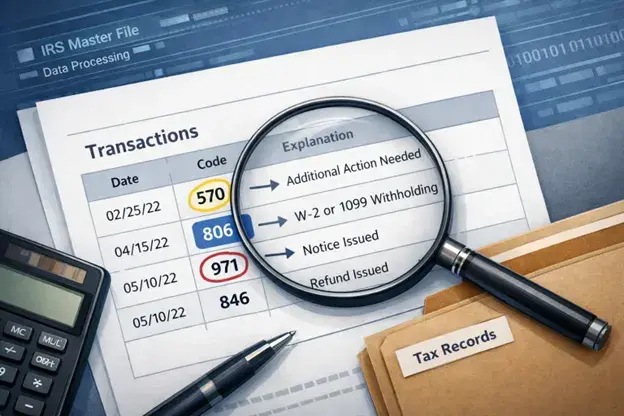
These codes appear on an IRS Account Transcript under the “Transactions” section and help explain the current status of a tax return.
IRS Processing Context (Recent Filing Season Data)
IRS filing data from a recent tax season shows that the agency received approximately 140.6 million individual tax returns and processed about 138.1 million, representing nearly 98 percent completion.
The IRS also issued around 86 million refunds totaling approximately 253.1 billion dollars, with an average refund of 2,942 dollars.
At the same time, around 3.4 million returns were still being processed or held for review due to identity verification checks, error resolution reviews, income mismatches, or fraud prevention filters.
These processing stages are commonly reflected in IRS transcript codes such as 570 and 971.
What Is an IRS Transcript
An IRS transcript is an official summary of your tax account activity. It includes:
- Tax return filing status
- Income and withholding records
- IRS adjustments and notices
- Refund and payment activity
- Transaction codes showing processing stages
You can access your transcript for free using the IRS “Get Transcript” tool on IRS.gov or through the IRS2Go mobile app.
Most Common IRS Transcript Codes Explained
Code 150 Return Filed and Tax Assessed
Code 150 confirms that your tax return has been received and processed for initial tax calculation.
This code does not guarantee refund approval. It only confirms that the IRS has recorded your return.
Code 806 Federal Tax Withholding Credit
Code 806 represents federal tax already withheld from your income during the tax year.
This includes W-2 withholding and other reported tax payments.
Why it may appear more than once
Code 806 can update if:
- Your employer submits corrected W-2 or payroll data
- IRS updates withholding records during processing
- Additional reporting documents (such as 1099 updates) are received
Small differences compared to your W-2 are usually timing or reporting updates. Larger differences may require correction with your employer or review with the IRS.
Code 570 Additional Review or Temporary Hold
Code 570 means your refund or account has been placed on temporary hold while the IRS reviews your return.
Common reasons include:
- Income mismatch between IRS and employer records
- Tax credit verification (such as refundable credits)
- Identity verification flag
- Random compliance or fraud screening
Timeline expectations
Most Code 570 cases are resolved in approximately 2 to 8 weeks, but timing varies depending on case complexity and IRS workload. During peak filing seasons or identity verification cases, delays may be longer.
When to be concerned
If Code 570 remains unchanged for more than 10 to 14 weeks without updates, additional review or follow-up may be required.
Code 971 Notice Issued
Code 971 indicates that the IRS has issued an official notice related to your tax account.
Common triggers:
- Identity verification request
- Explanation of refund adjustment
- Request for additional documentation
- Follow-up after review or hold codes
Identity verification process may include:
- Online verification through IRS identity systems (ID.me in many cases)
- Uploading documents through IRS secure portals when requested
- Phone verification with IRS support
- Submitting documents such as government ID, W-2, or 1099 forms
IRS mail typically arrives within 5 to 10 business days after Code 971 appears.
Code 846 Refund Issued
Code 846 confirms that your refund has been approved and issued.
The date shown represents the IRS issue date, not delivery date.
Refund delivery timelines:
- Direct deposit: 1 to 5 business days after issuance
- Bank processing may add 1 to 2 additional days
- Paper check: 5 to 21 days depending on postal delivery
Code 571 (Important Related Code)
Code 571 is less common but indicates that a previous hold (often Code 570) has been resolved or released.
It may appear when:
- A refund hold is lifted
- Adjustments are completed
- Processing continues toward refund issuance
Common IRS Transcript Code Sequences
Standard Refund Processing
150 → 806 → 846
Normal processing with no delays.
Verification Review Case
150 → 806 → 570 → 971 → 846
Temporary hold followed by IRS review and final refund approval.
Extended Review Case
150 → 806 → 570 → 570 → 971 → 571 → 846
Longer verification process that eventually resolves after additional IRS review and release of hold.
What to Do If You See Code 570 or 971
Step 1
Do not panic. These codes are often part of normal IRS processing.
Step 2
Wait for official IRS correspondence before taking action.
Step 3
Respond promptly if identity verification or documents are requested.
Step 4
Continue checking your IRS transcript for updates every few days or weekly.
If the situation is unclear or continues beyond expected timelines, working with Tax Resolution Experts can help interpret IRS notices and prevent unnecessary delays.
When You Should Be Concerned
Further action may be needed if:
- Code 570 remains unchanged beyond 10 to 14 weeks
- Multiple notices appear without resolution
- Refund status does not progress over an extended period
- IRS requests additional documentation repeatedly
Delays vary based on IRS workload, identity verification requirements, and case complexity.
If You Disagree With IRS Changes
If your transcript shows unexpected adjustments, the response depends on the situation:
- Minor calculation or filing errors may be corrected by submitting supporting documents
- Credit or deduction disallowances require documentation and formal IRS review
- Identity verification holds cannot usually be “disputed” and must be resolved through verification
In complex cases, taxpayers may request clarification from the IRS or work with Tax Resolution Experts to evaluate available options.
Where to Check Your IRS Transcript
You can access your transcript through:
- IRS Get Transcript tool on IRS.gov
- IRS2Go mobile application
Key Takeaway
IRS transcript codes show how your tax return is moving through IRS processing stages.
Some codes indicate normal processing, while others show temporary holds or required verification. Most delays are resolved automatically once IRS review is complete.
Disclaimer
This content is for informational purposes only and does not constitute tax or legal advice. IRS procedures and timelines may vary based on individual circumstances.