



What is an IRS Notice of Tax Deficiency
November 11, 2025
IRS Transcript Codes Explained: Code 570, 806, 971 & More
January 22, 2026
In 2024, the IRS added $84.1 billion in penalties to individual and small-business tax returns, according to the 2024 IRS Data Book.
As a small business owner or a self-employed individual, missing deadlines or failing to plan your taxes can result in IRS penalties, and, ultimately, a huge loss of money.
Tax preparation and planning are two essential tools to help you stay compliant and protect your wealth. Each has a distinct purpose, though they are often confused as the same thing.
In this tax preparation vs tax planning comparison, we will explain these strategies, their differences, and why both are essential for effective financial management.
What is Tax Preparation?
Tax preparation is the process of preparing and filing a fiscal year's tax return. It involves gathering financial information and completing forms to file your tax returns with the IRS and your state. Tax preparation aims to avoid IRS penalties and issues altogether. For this purpose, it reviews your financial activity from the previous year to verify that everything is reported correctly and filed on time.
Learn more about what happens when you file your taxes late.
Key Steps of Tax Preparation:
Tax preparation involves several key steps, including the following:
- Collecting financial documents such as W-2 and 1099 forms, receipts, and bank statements
- Filling out the right tax forms, including Form 1040 for individuals and Form 1120 for corporations
- Calculating how much tax you owe (or how much you’ll get back)
- Submitting everything to the federal and state authorities by the deadline.
These steps are completed once a year during the tax season. This period mostly runs between January and April. The process itself requires only 1 or 2 trips to your accountant, during which you need to hand over all required documents to prepare your tax return.
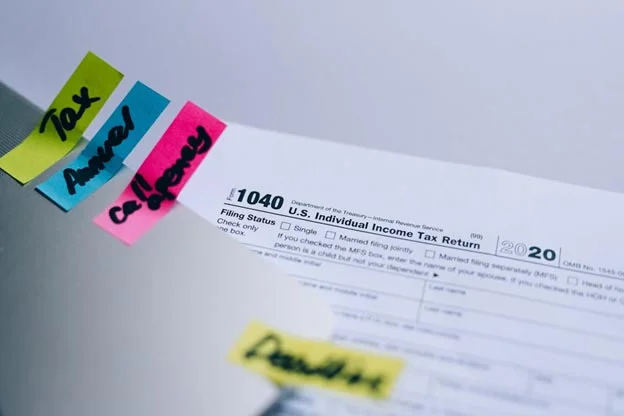
Source: Pexels
What is Tax Planning?
Tax planning is the process of strategically managing your finances and tax profile throughout the entire year. So, unlike tax preparation, it is built into your regular financial decisions. The goal is to reduce your tax burden in the following years and save more of your wealth.
In addition, it helps you achieve long-term goals, such as retirement. To achieve this, it takes advantage of carefully executed strategies that avoid common tax problems while helping you build wealth for the future.
The Key Stages of Tax Planning:
Tax planning involves several key activities, including:
- Reviewing your current income, expenses, and tax situation to know where you stand.
- Estimating what you may owe later in the year so there are no surprises.
- Identifying ways to save taxes, such as claiming eligible deductions and credits, deciding when to receive income, or choosing the best time to pay certain expenses.
- Planning major business actions such as buying equipment, hiring staff, or making investments, so they are structured in the most tax-efficient way possible.
- Adapting your plan according to the IRS tax changes and the needs of your growing business.
Key Differences Between Tax Planning vs Tax Preparation
The main difference between tax planning and preparation lies in their purpose and benefits. To help you understand which services you need and when, here’s a quick look at their differences.
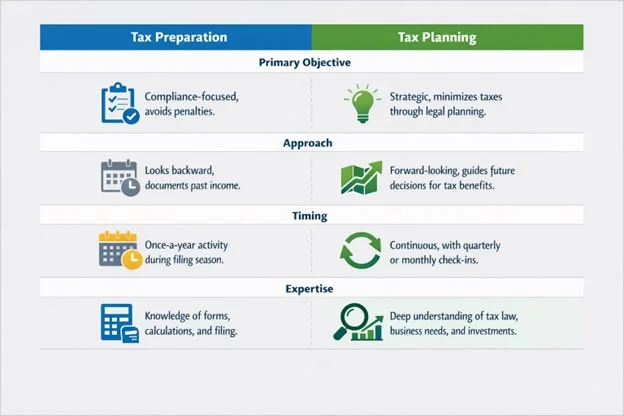
Let’s review these differences in detail.
1. Primary Objective
The main objective of tax preparation is to ensure compliance. This means avoiding penalties and staying on the right side of the IRS. On the other hand, tax planning is a strategic approach. It helps you reduce what you owe through legal strategies and smart financial structuring. The best part? There are many reliable Tax Resolution Services that help you achieve both these objectives.
2. Approach
Tax preparation looks backward at your financial activity in the previous year. This means it reviews transactions that have already happened and documents the income you have already earned. Meanwhile, Tax planning has a forward-looking approach. It looks at your future financial decisions to minimize penalties and maximize your tax benefits.
For example, if you plan on buying a company vehicle, tax preparation means documenting your purchase after it has already been made. Meanwhile, tax planning advises you to wait for the optimal timing and whether to lease or buy for maximum tax benefit.
3. Timing
Tax preparation is a limited once-a-year activity. It occurs during the specific months for tax filing. In contrast, tax planning is a continuous process that occurs throughout the entire year. During this time, your tax adviser will check in quarterly or, sometimes, every month to adapt planning strategies to your current situation.
4. Expertise
A tax preparer should understand the current tax forms, how taxes work, how to do the calculations correctly, and how to file them properly. In comparison, tax planning requires a deeper understanding of the entire tax law, the needs of your business or industry, predicting future finances, and seeing how different decisions can affect your cash flow, investments, or retirement savings.
Accordingly, a career in tax planning or preparation requires specific credentials.
Credentials Required to Qualify for Tax Preparation & Planning
To prepare or plan your taxes, you need a skilled professional who can help you file your taxes on time and make the most of your tax benefits. Let's review the requirements for a tax preparer and a planner.
Who Can Provide Tax Preparation Services?
According to the IRS, anyone can be a tax preparer if they have an IRS Preparer Tax Identification Number or PTIN. However, based on their credentials, each tax preparer has different representation rights.
Only Enrolled Agents (EAs), Certified Public Accountants (CPAs), and attorneys have unlimited representation rights before the IRS. In contrast, a tax preparer with only a PTIN and no credentials cannot represent clients before the IRS.
So, if you’re wondering how to become a certified tax preparer, make sure you meet these requirements and understand relevant limitations.
Who Should Handle Tax Planning?
There are no official government guidelines for the eligibility of a tax planner. Still, you want to make sure they are highly skilled in US tax law and its regulations. In most cases, this means working with a CPA, an enrolled agent, or a professional with specialized credentials.
In addition, your tax planner should be experienced in your specific industry. That’s because a tax planner who works with real estate investors will use very different strategies than one who focuses on e-commerce businesses. So, make sure to confirm their experience with businesses like yours and ask for references.
Business Tax Planning and Preparation: Why You Need Both
Tax planning and preparation are two sides of the same coin. When combined, each can help you create the best outcomes for your business.
Tax planning helps you track deductions and organize records throughout the year as part of your planning process. As a result, filing your tax returns becomes easier and less stressful.
Similarly, effective tax preparation can help you find patterns, missed opportunities, and areas where you can improve. So, the knowledge of your last year's return sets the foundation for your future tax planning. As a growing business, these strategies can help you plan strategically and grow your finances.
Final Words
To sum up, tax preparation vs tax planning, each has a unique purpose. Tax preparation ensures your returns are accurate and filed on time. Tax planning, on the other hand, helps you make smarter decisions to reduce risk and improve outcomes.
A skilled professional can help you effectively combine these strategies based on your business’s unique financial situation. At Mykarme, we provide expert individual and business tax services to prepare and plan your taxes or resolve existing IRS issues. Our mission is simple: help you thrive and become more financially stable. Contact us today to get started.