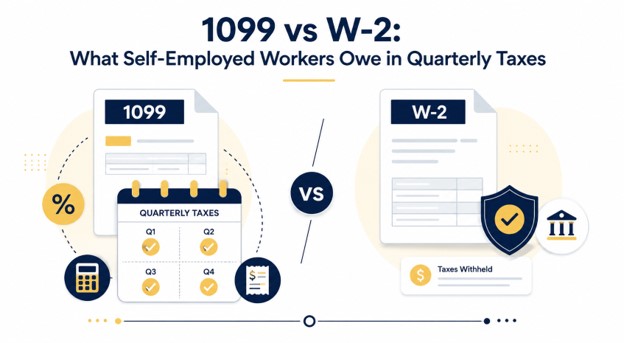
A W-2 worker is a traditional employee whose taxes are withheld by an employer from each paycheck. A 1099 worker is an independent contractor who handles and pays their own taxes, which includes federal income tax and a 15.3% self-employment tax for Social Security and Medicare.
This guide gives you a clear 1099 vs W-2 comparison, so you can learn what each type of form means, their tax differences, and core benefits and limitations.
Also, estimated tax rules can be tricky to get right. A certified tax preparation service can help you calculate your accurate tax liability and stay compliant with IRS deadlines to avoid penalties or underpayment interest.
What Does 1099 Mean?
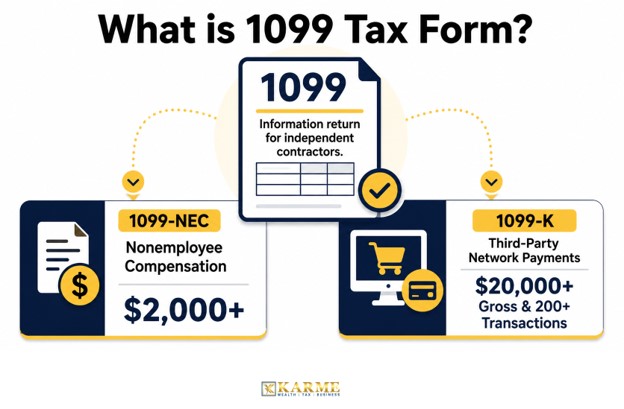
1099 is an IRS tax form used to report certain types of income paid to people who are self-employed, such as freelancers, independent contractors, or investors.
There are several types of 1099 forms, but two are especially important:
- The 1099-NEC covers nonemployee compensation above $2,000, updated on December 31, 2025.
- The 1099-K covers payments processed through third-party platforms like PayPal or Stripe. It applies only once a worker crosses $20,000 in gross payments and completes more than 200 transactions in a year.
What is a W-2 in the US?
A W-2 form is a tax document that shows you how much your employer paid you and how much they withheld for federal income tax, Social Security, and Medicare during the past year.
As a W-2 employee, your employer calculates the taxes, deducts them from each paycheck, and sends the withheld amounts to the IRS on the required schedule. The employer must also provide you with a W-2 by January 31 of the following year.
1099 vs W-2: Key Tax Differences
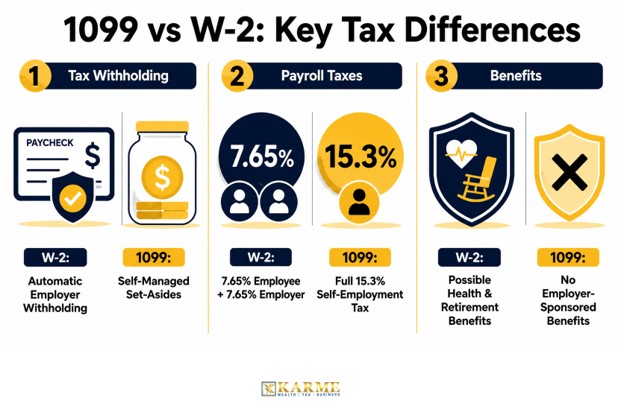
The specific tax differences between a W-2 employee vs 1099 contractor are listed below.
- Tax withholding: Employers of W-2 workers automatically withhold taxes from their paychecks. 1099 contractors set aside money for taxes themselves. A payroll tax calculator can help estimate the amount.
- Payroll taxes: W-2 employees pay 7.65% in FICA taxes, with employers paying another 7.65%. 1099 contractors generally pay the full 15.3%.
- Benefits: W-2 employees may receive health insurance, retirement contributions, or other benefits. 1099 contractors typically receive no employer benefits.
As only 1099 workers are mostly responsible for paying their own taxes, let’s see what they owe.
What Do 1099 Self-Employed Workers Owe in Quarterly Taxes?
According to the IRS, 1099 self-employed workers must make estimated payments if they expect to owe $1,000 or more in taxes for the year. Their quarterly tax payment includes a 15.3% self-employment tax plus the regular federal income tax bracket rate.
Here is how it works.
Payment Deadlines
For 2026, estimated tax payments for W2 or 1099 are due April 15, June 15, September 15, and January 15, 2027. Each deadline covers a different payment period. If you miss a payment, the IRS calculates any underpayment penalty separately for that period. Karme’s overview of quarterly tax payments explains what each payment covers.
Safe Harbor Rules
The safe harbor rule can help you avoid an underpayment penalty. Generally, you need to pay at least 90% of your current year’s tax or 100% of your previous year’s tax. If your previous year’s adjusted gross income was more than $150,000, the requirement increases to 110%, according to the IRS. For example, if you owed $16,000 in taxes last year, you could pay $4,000 each quarter to meet the 100% safe harbor threshold.
Underpayment Penalties
The IRS may charge a penalty if you do not pay enough in estimated taxes. It calculates the penalty separately for each payment period. The rate is based on the federal short-term rate plus 3 percentage points and can change quarterly. For example, the rate was 7% for the third and first quarters of 2026.
Pros and Cons of 1099 Work
With 1099 work, you give up some employer-provided stability in exchange for more control over your schedule, rates, and business expenses.
Here are the specific pros and cons.
Pros:
- Sets own schedule and negotiates rates per project
- Deducts legitimate business expenses on Schedule C
- Can contribute up to $72,000 in 2026 through a Solo 401(k)
Cons:
- Pays the full 15.3% self-employment tax alone
- No employer-sponsored health coverage or retirement match
- Handles quarterly estimated tax filings without automatic withholding
Some contractors manage the tax and liability side by forming an LLC or S-corp to structure income differently.
Pros and Cons of W2 Work
Unlike 1099 work, a W-2 job gives you less flexibility and earning potential in exchange for more predictable pay, automatic tax withholding, and employer-provided benefits.
Pros:
- Receives predictable paychecks with taxes withheld automatically
- Splits FICA tax with the employer instead of paying it alone
- Typically qualifies for health insurance and retirement matching
Cons:
- A fixed schedule set by your employer
- Cannot deduct unreimbursed job expenses under current tax law
- Fixed pay set by employer bands, not negotiated rates
FAQs
Q1. Can someone receive both a W-2 and a 1099 in the same tax year?
Yes. If you work full time as an employee and also earn freelance income, you may receive both a W-2 and a 1099. The IRS combines all income when calculating what’s owed for estimated tax purposes.
Q2. Is 1099 self-employed income?
Yes, the income is treated as self-employment income if you receive a 1099-NEC for services you performed as a freelancer or independent contractor. You will report the income and related business expenses on Schedule C (Form 1040) and calculate applicable self-employment tax.
Q3. Do 1099 contractors owe state estimated taxes too?
Yes, 1099 contractors owe state estimated taxes if they live in a state with an income tax. States have their own quarterly payment systems, deadlines, income thresholds, and forms. Be sure to check your specific requirements along with the federal rules.
Q4. What happens if 1099 income is seasonal or irregular?
If your income changes significantly from quarter to quarter, you can use the annualized income installment method on Schedule AI of Form 2210. This bases your estimated payments on the income you actually earn during each quarter.
Q5. Can a W-2 employee also owe quarterly estimated taxes?
Yes, a W-2 employee also owes quarterly estimated taxes if withholding doesn’t cover the full liability. This can happen with significant investment income, income from a working spouse, or earnings from a side business that has no tax withholding.
Q6. Does the Qualified Business Income deduction reduce a contractor’s tax bill?
Yes, eligible self-employed workers may deduct up to 20% of qualified business income. The OBBBA made this deduction permanent. It reduces taxable income and may lower the amount you need to set aside for estimated tax payments required annually.
Final Words
In the end, the difference between 1099 vs W-2 comes down to your employment type, how taxes are withheld, and the benefits you receive. If you are a 1099 independent contractor, you must file your quarterly amount by the deadline to avoid costly IRS penalties.
At Karme, we provide year-round tax preparation and planning for individuals and contractors. We can calculate your safe harbor amount and manage your quarterly payments, so you can stay on track and avoid unnecessary IRS penalties. Contact us today to get started.