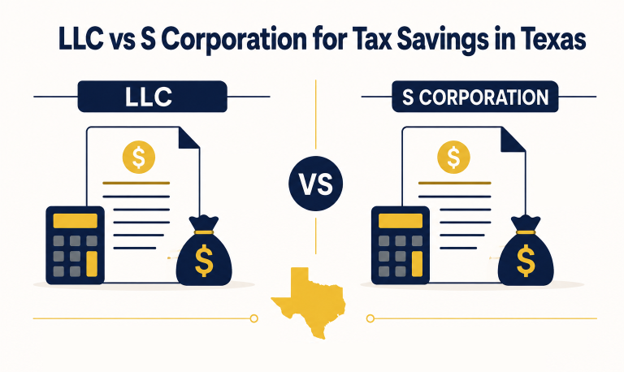
For a Texas LLC, S corp status can reduce self-employment tax by separating salary from tax-free distributions. But it requires reasonable compensation, payroll, and a separate 1120-S return. A default LLC is simpler, but its entire net profit remains subject to self-employment tax.
The right call between the S corp vs LLC in Texas depends on your profit, payroll setup, and how much extra administration you’re willing to take on. This guide explains how each option is taxed and how to choose the right fit for your Texas business.
It’s also easier to choose the right structure upfront than restructure later. A business formation service can help you compare your options before you file.
What’s the Difference Between an LLC vs S Corp in Texas?
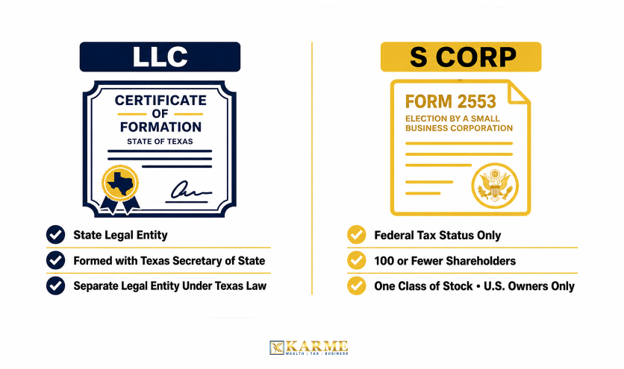
An LLC is a legal business structure created at the state level. In Texas, you form an LLC by filing a Certificate of Formation with the Texas Secretary of State and naming a registered agent. Once it is formed, the LLC becomes a separate legal entity in Texas.
An S corporation is a federal tax status (not a separate entity) created by filing IRS Form 2553. To become eligible, your business must have 100 or fewer shareholders, one class of stock, and no nonresident alien or corporate owners.
Also, when comparing S corp vs LLC in Texas, be aware that choosing S corp status does not change your underlying legal structure. So, a Texas LLC can remain an LLC under state law while choosing to be taxed as a Texas S corp or C corp.
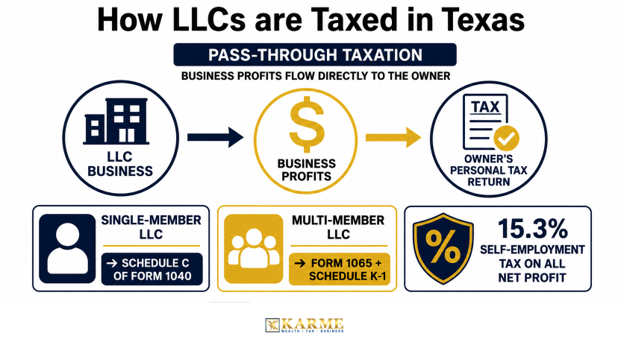
How LLCs are Taxed in Texas
A default Texas LLC is a pass-through entity for federal tax purposes. So, the profits pass through to the owners and are taxed on their personal returns.
Pass-Through Reporting:
Pass-through reporting depends on how the LLC is structured.
- Single-member LLC: profits are reported on Schedule C of Form 1040
- Multi-member LLC: profits are reported through Form 1065 and Schedule K-1
Self-Employment Tax:
The net profit also carries a 15.3% self-employment tax, which is split across Social Security and Medicare. According to the Social Security Administration, the exact rate for each is:
- 4% Social Security tax, subject to the 2026 wage base of $184,500.
- 9% Medicare tax, which has no standard income limit.
This profit is then taxed again at ordinary federal income tax brackets, on top of self-employment tax.
How an S Corp is Taxed in Texas
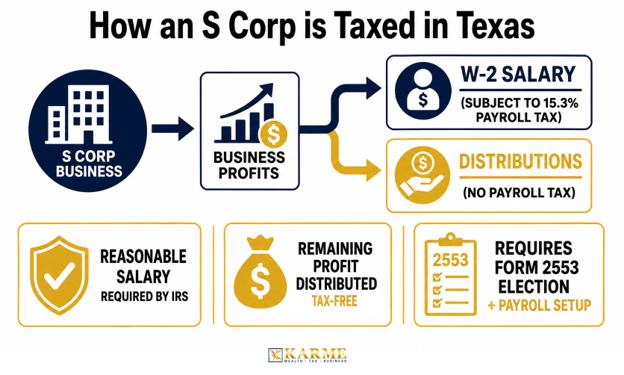
An S corp splits your income into two streams: W-2 salary and distributions. Your salary is subject to payroll taxes. Distributions are not. This tax difference is where the potential savings come from.
Reasonable Salary Rule
Before taking distributions, the IRS requires shareholder employees to pay themselves reasonable compensation through W-2 wages. This W-2 salary is subject to the 15.3% payroll tax.
Distributions and Savings
Once you pay yourself a reasonable salary, the remaining profit can be distributed to you without payroll tax. However, you need to file Form 2553, run payroll properly, and document a salary that you can reasonably defend. If you’re unsure how to approach this, professional S corporation services can help you with the initial election, payroll, and ongoing compliance.
Texas Franchise Tax for Both LLC and S Corp
Texas does not have a personal income tax. However, both LLCs and S corporations are still subject to the state’s franchise tax. For 2026, LLCs with annualized total revenue below or equal to the $2.65 million threshold do not owe franchise tax.
S Corp vs LLC in Texas: Comparing the Tax Costs
An S corp status can reduce payroll taxes, but you need to subtract the cost of a reasonable salary and the added administrative work from the payroll tax savings on distributions.
For example, suppose a Texas consulting LLC earns $120,000 in net profit.
- As a default LLC, the full $120,000 is subject to 15.3% self-employment tax.
- As an S corp, the owner takes a $70,000 reasonable salary (payroll tax of roughly $10,710) and a $50,000 distribution, which carries no self-employment tax.
That means roughly $7,650 in gross payroll tax savings. But these savings come with extra costs, such as:
- Payroll processing and quarterly payroll tax filings
- A separate business return (Form 1120-S)
- Additional accounting fees
- Formal salary documentation to support the reasonable compensation figure
When to Choose an LLC or S Corp in Texas
A default LLC can be a better fit for newer or lower profit businesses, especially when:
- The business is early-stage or pre-revenue
- Income fluctuates significantly from year to year
- Profits are still relatively low
- The potential tax savings of an S corp may not outweigh payroll and added compliance costs
In contrast, an S corp election makes more sense for business owners when:
- Profits are stable and predictable
- The business can support reasonable compensation for an owner who works in the business.
- Potential tax savings justify payroll and additional compliance costs
- The business meets S corp eligibility requirements
But S corps have eligibility limits. If you plan to bring in outside investors, add shareholders, or reinvest heavily for growth, a C corp may be a better fit. Professional C corporation services can help you weigh your growth plans, ownership goals, and long-term tax strategy.
FAQs
- Can a Texas LLC elect S corp status mid-year, and does it apply retroactively?
Yes. If you file Form 2553 within 2 months and 15 days of the tax year starting, the election applies retroactively to January 1. If you file later, the S corp election starts with the following tax year.
- Does the S corp election work differently for a multi-member LLC?
Yes. Working members become shareholder-employees who must receive reasonable compensation. Unlike partnerships, S corps allocate profits and losses according to ownership percentages and generally prohibit flexible special allocations.
- Can a business switch back to default LLC taxation after electing S corp?
Yes, you can. But once you revoke an S corp election, you cannot make another S corp election for five years. The IRS may allow an earlier election when there is a significant change in circumstances.
- Does Texas require a separate state-level S corp election?
No. Texas has no separate S corp election. The federal election doesn’t change franchise tax treatment. That’s because Texas taxes LLCs and S corps under the same entity-level rules.
- How does an S corp election affect health insurance deductions?
If the business pays health insurance premiums for a shareholder owning more than 2%, the premiums must be included in the shareholder’s W-2 wages. The shareholder can then claim the self-employed health insurance deduction on Form 1040.
- What’s the deadline for filing Form 2553?
You must file Form 2553 within 2 months and 15 days after the tax year begins for the election to apply that year. For a calendar-year business, the deadline is March 15.
Final Words
The S corp vs LLC in Texas decision ultimately depends on profit level, administrative capacity, and long-term ownership plans. Professional guidance can help you meet compensation and franchise tax requirements and avoid costly mistakes.
At Karme, our business tax team can run the numbers, document defensible reasonable compensation, set up S corp payroll correctly, and keep your franchise tax filings on track. Whether you are starting a new business or reconsidering your current structure, contact us today to discuss the right approach for your business.