
Once your business becomes more profitable, it’s time to move beyond a sole proprietorship or partnership. These structures can leave your personal assets exposed and limit how you manage business income.
That is why choosing the right corporate structure is an important next step. It affects your taxes, ownership options, and annual filing requirements.
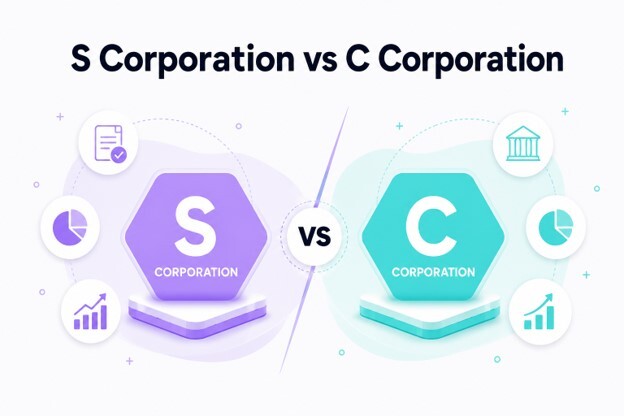
This guide offers a complete s corp vs c corp comparison, so you can understand the key differences and benefits of each structure before selecting the right one for your business.
Before filing your formation documents, consider consulting a business formation service. Professional guidance can help you select the right structure based on your current needs and long-term growth plans.
C Corporation vs S Corporation: Exploring the Basics
A C corporation is the default tax status for an incorporated business. If you form a corporation and do not choose a different tax election, the IRS automatically treats it as a C corporation under Subchapter C of the Internal Revenue Code.
An S corporation is not a separate legal business entity. Instead, it is a tax election that an eligible corporation or LLC makes by filing IRS Form 2553. Once approved, the business passes its income, losses, and tax credits directly to the owners’ personal tax returns, instead of paying federal income tax at the corporate level.
C Corp vs S Corp Taxation Explained
The biggest difference between a C corp and an S corp lies in how each entity must tax its profits. Here’s how it works.
Double Taxation
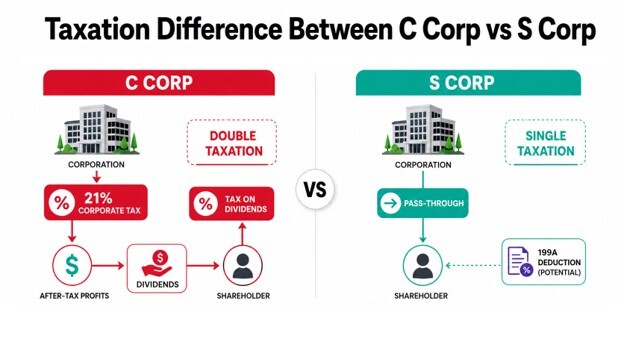
A C corp pays a flat 21% federal tax on its profits. If the company then pays those profits to shareholders as dividends, the shareholders pay tax on that income again. This is called double taxation, and it is one of the main differences in any C vs. S corporation comparison.
Because of this, many C corp owners use proactive tax planning to decide how much profit to reinvest in the business and how much to distribute as dividends.
Pass Through Advantage
Instead of paying tax at the business level, an S corp passes its profits directly to shareholders. The shareholders then pay tax once at their individual federal tax brackets.
Moreover, shareholder employees can receive part of their income as W-2 wages, which are subject to payroll taxes, and part as distributions, which are not. This approach can reduce their overall tax bill.
The tax benefit became even more valuable after the One Big Beautiful Bill Act, signed on July 4, 2025. The law made the Section 199A Qualified Business Income Deduction permanent. As a result, eligible S corp shareholders can continue deducting up to 20% of their qualified pass-through income.
Ownership and Compliance Difference between S Corp and C Corp
Beyond taxes, A C corp and an S corp also differ in who can own the business and what it takes to stay compliant. Here’s a look at their key differences.
Shareholder Restrictions
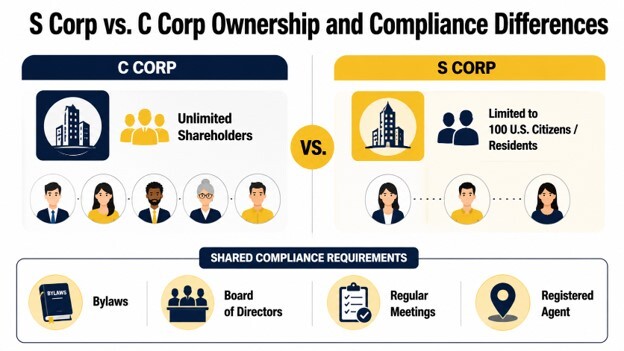
C corps can have unlimited shareholders, including individuals, corporations, and foreign investors. Meanwhile, S corps are limited to 100 shareholders, and they must be U.S. citizens or residents.
Even with those limits, S corps remain popular. IRS data for tax year 2022 shows that S corps, REITs, and RICs made up 77.3% of the 6.8 million active corporate tax returns filed that year.
Ongoing Compliance Duties
An S corp is a tax election, not a separate legal entity. So both C corps and S corps must follow the same corporate formalities:
- bylaws
- a board of directors
- annual meetings
- a registered agent for legal and state notices
S corp owners who work in the business also must pay themselves a reasonable salary through payroll before taking distributions. The IRS watches this closely to prevent payroll tax avoidance.
C Corporation vs S Corporation: Key Benefits of Each Structure
A C corp and an S corp each offer several practical advantages, based on whether you want to attract investors, offer employee benefits, or make succession easier.
C Corporation Advantages
Here are the main benefits to keep in mind:
- Fully deductible employee benefits, like health insurance and retirement plans
- Unlimited shareholders and easy stock transfer attract outside investors
- Multiple stock classes allow flexible ownership and funding structures
- No limit on number of shareholders, which makes it ideal for scaling and going public
- The corporation continues even after an owner dies or leaves.
S Corporation Advantages
An S corp offers the following key benefits:
- Pass-through taxation avoids the double taxation C corps face
- Splitting salary and distributions can lower self-employment tax
- Section 199A lets shareholders deduct up to 20% of income
- Owners can deduct business losses against personal income
FAQs
Q1. Can an LLC elect to be taxed as an S corp or a C corp?
Yes. An LLC is a legal business structure, not a tax classification. It can file Form 2553 to be taxed as an S corp or Form 8832 to be taxed as a C corp while still keeping its LLC liability protection.
Q2. Can a C corporation later convert to an S corporation?
Yes, as long as it meets the S corp eligibility rules and files Form 2553. However, timing is important. If the company sells appreciated assets within five years of the conversion, it may owe built-in gains tax.
Q3. Can non-U.S. residents own shares in an S corporation?
No. S corp shareholders must be U.S. citizens or resident aliens, with a few exceptions for certain trusts and estates. Nonresident aliens can own shares in a C corporation, but not an S corp.
Q4. Do S corps and C corps face different state-level taxes?
In many cases, yes. Some states tax S corps at the business level or charge a franchise fee, even though they receive federal pass-through treatment. C corps usually pay standard state corporate income tax. Keep in mind that the rules vary by state.
Q5. What happens if an S corp accidentally violates its eligibility rules?
If an S corp breaks the eligibility rules, such as having more than 100 shareholders or issuing a second class of stock, the IRS can end the S corp election right away, and the business goes back to C corp taxation.
Q6. How much does it cost to set up each structure?
State filing fees, registered agent costs, and bylaws are generally similar for both structures. Filing the S corp election with the IRS is free. However, S corps have higher ongoing costs because of payroll compliance.
Final Words: Choosing the Right Structure for Your Business
In the end, the choice between a C corp vs S corp depends on your growth plans and how you want to handle profits and benefits. If you plan to raise venture capital or reinvest most of your earnings, a C corp is usually the better fit. If you run an owner-operated business and want to avoid double taxation, an S corp is the smarter choice, as long as you stay within the shareholder limit.
Since every business has different priorities, a professional business formation service can help you choose the right entity and align it with your tax strategy and future goals.
At Karme, we simplify business management by handling everything from entity selection, business registration, and EIN setup to accounting, payroll, tax planning, and registered agent services. With all these essentials under one roof, you can rely on a single trusted partner instead of working with multiple providers. Schedule a consultation today to get started.