

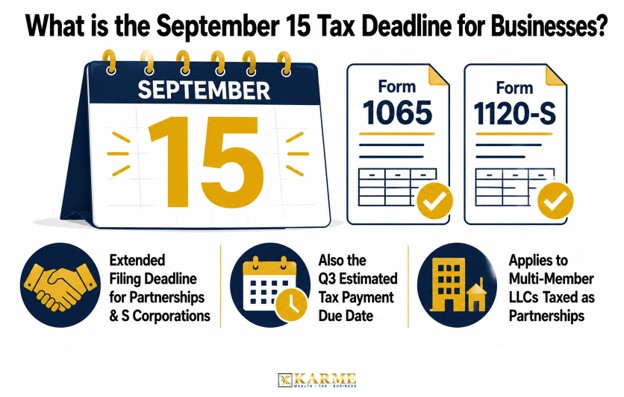
September 15 is the due date for Q3 estimated tax payments and the extended filing deadline for calendar year partnerships and S corporations that filed Form 7004 for their 2025 tax returns. Missing the filing deadline can cost a $255 per-owner, per-month penalty. Meanwhile, missing the Q3 payment triggers daily-compounding interest at 7% on the shortfall.
This article explains exactly what tax deadline is September 15 for businesses, what happens if you file late, and what you can do if it has already passed. To stay on top of important tax deadlines like September 15, many business owners also use professional business tax services to stay compliant and avoid costly penalties.
What Tax Deadline is September 15 for Businesses
September 15 is the extended federal tax filing deadline for calendar year partnerships and S corporations that file Form 1065 or Form 1120-S. It is also the due date for the third-quarter estimated tax payment for businesses and self-employed individuals.
For these businesses, the original filing deadline is March 15. If the business filed Form 7004 for a six-month extension, September 15 becomes the extended filing deadline.
Who Must File by September 15?
The September 15 deadline generally applies to:
- Partnerships that use a calendar tax year and file Form 1065
- Multi-member LLCs taxed as partnerships
- S corporations that use a calendar tax year and file Form 1120-S
Once these entities file Form 7004, it provides them with additional time to file their tax returns, but it does not extend the time to pay taxes that are due.
Penalties for Missing the September 15 Tax Deadline
If you file your taxes late or miss the September 15 tax deadline, the IRS can charge a penalty for every owner listed on the return. Here’s exactly how it works.
The Per-Owner Penalty
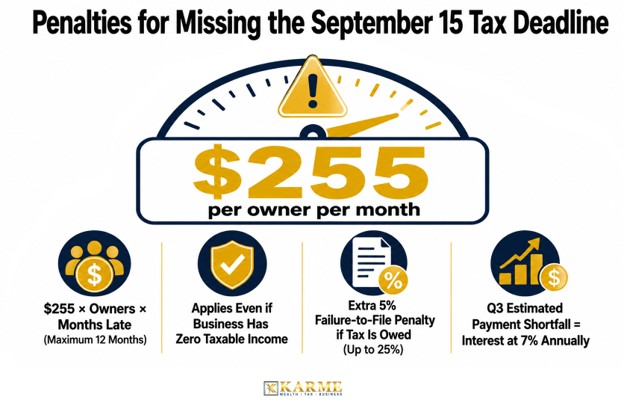
The penalty includes $255 per shareholder or partner for each month or partial month the return is late, up to 12 months. It applies even when the business has zero taxable income.
For example, a three-owner S corporation that files two months late could owe $1,530 in penalties. That is $255 multiplied by three owners and two months. So, the longer the issue remains unresolved, the more difficult the tax debt can become to manage.
When Tax is Also Owed
If the business owes tax, the IRS can assess a separate failure-to-file penalty on top of the per-owner penalty. This penalty is 5% of the unpaid tax for each month or partial month the return is late, up to 25%. If the return is more than 60 days late, a minimum penalty of $525 may apply, or 100% of the unpaid tax if that amount is lower.
Missing the Q3 Estimated Payment
The Q3 payment penalty works differently. Instead of a flat fee, the IRS charges interest on the underpayment of estimated tax. This is currently 7% annually for the third quarter of 2026 and compounds daily until it’s paid.
Also, pass-through entities like partnerships and S corps typically don’t pay estimated tax themselves. Therefore, this charge applies to each owner’s personal return based on their share of business income. So it is applied individually, not at the entity level.
Consequences Beyond the Penalty
Apart from a financial penalty, filing late can create issues that affect the business, its owners, and its future tax filings. Here are the exact consequences you might face.
Delayed Schedule K-1s
A late partnership or S corporation return can delay the Schedule K-1 forms issued to its owners. Owners need their K-1 to file their personal return, so a delay may force them to request their own extension. Otherwise, if they already filed, they will need to submit an amended return once the corrected K-1 arrives.
IRS Notices and Scrutiny
Once a filing penalty posts, the IRS sends an automatic notice detailing the amount and reason. A missed Q3 payment triggers its own IRS penalty notices too, since interest keeps accruing until the balance is paid in full. A pattern of late filings or underpayments across multiple years can draw closer IRS attention to the entity’s overall compliance history.
Steps to Take If You Already Missed the September 15 Deadline
If you’ve already missed the Sept. 15 tax deadline, here are a few things you can do.
File the Return Right Away
The first step is to file your return as soon as you can. This will help you minimize the penalties for each month or partial month the return remains unfiled.
File Now, Then Address the Balance
Another option is to file the return first, then pay as much of the balance as you can afford. A partial payment reduces the unpaid balance, which can also reduce the amount of interest that continues to accrue.
If you still cannot pay the remaining balance, you may be able to settle your tax debt using IRS payment plans or tax resolution options to manage the debt over time.
Check for Automatic Penalty Relief
You may not have to pay the full amount of certain penalties if you qualify for first-time penalty relief. The IRS has now introduced an Automatic Exemption from Penalty (AEP) process that applies penalty relief during return processing when a taxpayer has a qualifying history of timely filing and payment, without requiring a request.
So, if you are dealing with business tax debt, check your account to see whether this relief has already been applied before assuming you owe the full penalty amount.
FAQs
Does September 15 apply to sole proprietors or single-member LLCs?
No. Sole proprietors and single-member LLCs report business income on their personal tax returns. So, their extended deadline is October 15 when filing Form 1040, not September 15.
Can a business request a second extension past September 15?
No. The IRS does not provide another extension for partnerships or S corporations. Form 7004 already provides a six-month extension.
Does the penalty apply if the S corporation had a loss for the year?
Yes. The penalty can apply even if the S corporation had a loss or no income. That is because the penalty is based on filing the return late, not on whether the business owed tax.
What if the business dissolved or stopped operating during the year?
The business still needs to file a final return for the period it was active. If that final return is filed late, penalties can still apply.
Is there a separate September 15 deadline for state tax?
It depends on the state. Many states follow the federal deadline for pass-through entities, but not all of them do. Check your state’s specific deadline instead of assuming it matches the federal date.
Will missing the deadline affect the business’s S-corp election status?
A single late filing generally does not revoke an S corporation election by itself. However, repeated noncompliance can lead the IRS to review the election.
Final Words
Missing the deadline can be costly, but it is not a lost cause. Understanding what tax deadline is September 15 and what it means for your business is an important first step toward avoiding unnecessary penalties.
If you are dealing with an extension, an unfiled return, or a growing IRS balance, Karme can help. We combine proactive business tax planning with tax resolution support to help you file accurately, address penalties, and create a compliance plan that fits your situation. If you want to prevent the problem from getting worse, now is the right time to take action. Contact our team today.