
Filed an extension back in April? October 15 deadline is the final IRS date for filing an extended individual tax return. If you miss it, you could face a failure to file penalty and additional interest.
A complete checklist can help you confirm that you have all required tax documents, payment records, deductions, credits, and final tax figures ready before you submit.
This article walks you through a practical checklist for the days leading up to October 15. You will know exactly what to review, from documents and payments to your final tax figures.
You can also work with a professional tax preparation service to review your deductions and credits and ensure your extended return is filed correctly.
What is the October 15 Tax Deadline?
The October 15 tax deadline is the extended federal filing deadline for individual taxpayers who requested a six-month extension by filing IRS Form 4868 by the original tax deadline. For calendar year taxpayers, it is the final date to file an extended federal income tax return without a late filing penalty.
However, this important deadline only applies to filing your tax return, not paying your taxes. This means filing an extension does not extend the time you have to pay your tax liability. It only gives you more time to submit your completed paperwork. If you owe any federal income tax for the previous tax year and did not pay the amount due by April 15, the IRS can charge interest and a failure to pay penalty.
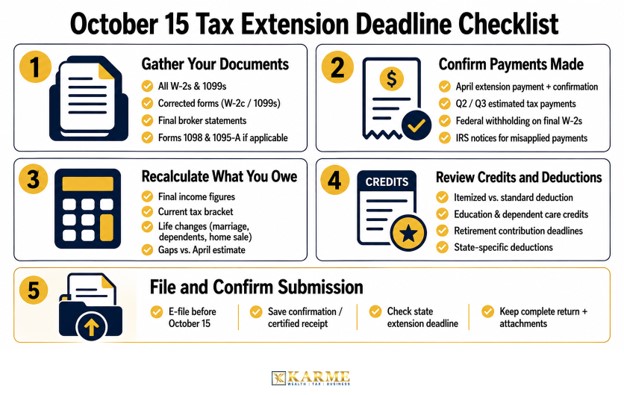
October 15 Tax Extension Deadline Checklist
This checklist covers the exact steps to confirm before submitting a return on extension, in the order you should complete them.
1. Gather Your Documents
Start by making sure you have every tax document you need. Missing documents are a common reason extended returns contain errors or leave out income. Some forms may arrive or get corrected months after the April deadline, so a final review is especially important. Keeping a document checklist can help you review any gaps and ensure your paperwork is complete.
Here’s what you’ll need to check.
- Confirm that you have every W-2 and 1099.
- Check for corrected forms, such as W-2c and corrected 1099s.
- Pull your final broker tax statements instead of draft versions.
- Locate Forms 1098 and 1095-A if they apply to you.
2. Confirm Payments Made
Next, compare the payments you made with the amount you owe. This ensures your tax return gives you credit for all payments already made. Include your extension payment and any quarterly estimated tax payments you made after filing for the extension.
Here is what to confirm before the October tax extension deadline:
- Record your April extension payment and confirmation number.
- Add any Q2 or Q3 estimated tax payments you made.
- Match the federal income tax withholding shown on your final W-2s.
- Check any IRS notices for misapplied payments.
3. Recalculate What You Owe
April estimates can be rough and based on partial income or projected figures instead of final numbers. Now that your documents are complete, your current income tax brackets may look different from what you paid in the spring. So, check the numbers again before you file.
Here are the exact steps to take.
- Rerun the numbers with final income figures
- Check which tax bracket applies this year
- Account for life changes (marriage, new dependent, home sale)
- Flag any large gap versus the April estimate
4. Review Credits And Deductions
Some tax benefits may not have been finalized when you filed your extension in April. For example, you may have been missing records or still waiting for final income and expense amounts. So, review your tax information again before any remaining contribution deadlines pass.
Here’s what to do:
- Compare itemized vs. standard deduction with final numbers
- Confirm eligibility for education or dependent care credits
- Check retirement account contribution deadlines already passed
- Verify state-specific deductions are claimed correctly
5. File And Confirm Submission
After reviewing your deductions, credits, and other tax information, file your tax return. Make sure you have proof that the IRS received your return, especially if you file close to the October 15 deadline.
Here are the specific steps to take.
- E-file your return before October 15 when possible.
- Save your e-file confirmation or certified mail receipt.
- Check your state’s tax extension deadline separately.
- Keep a complete copy of your tax return and all attachments.
What Happens If You Miss the October 15 Deadline
If you miss the October 15 tax deadline, the IRS may charge a failure-to-file penalty. If you also have unpaid taxes, a failure to pay penalty and interest may apply.
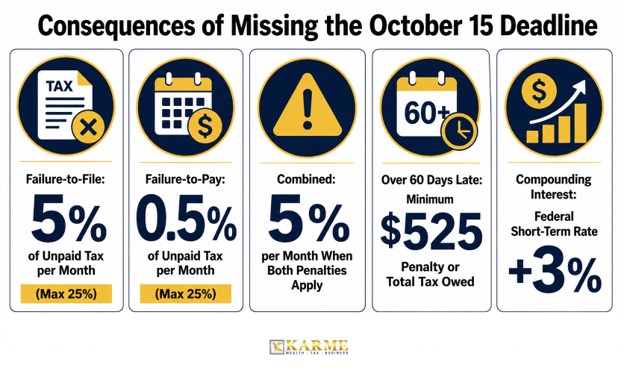
According to the IRS, the penalties include the following:
- Failure-to-file penalty: 5% of unpaid tax per month, up to a maximum of 25%
- Failure-to-pay penalty:5% of unpaid tax per month, up to a maximum of 25%
- Combined penalties: 5% per month when both apply in the same month
- Return more than 60 days late: Minimum $525 or the total tax owed, whichever is smaller
- Compounding interest: Based on the federal short-term rate plus 3%, adjusted every quarter.
FAQs About the October 15 Deadline
Q1. Can you file taxes after October 16?
Yes. You can file your federal tax return after October 16. However, filing your taxes late can result in a failure-to-file penalty and interest on the unpaid tax. Filing as soon as possible can help reduce additional costs.
Q2. Does the October 15 extension apply to state tax returns too?
No. The federal extension does not automatically extend your state tax deadline. Each state has its own filing deadlines and extension rules. While some states use October 15 as an extended deadline, others may use a different date.
Q3. What happens if I’m owed a refund and miss October 15?
You generally will not owe a late filing penalty if you are due a federal tax refund. However, you must file your tax return before the IRS can issue your refund. Filing sooner allows you to receive the refund sooner.
Q4. Can I get a second extension past October 15?
No. Most individual filers cannot get a second extension after October 15. Only specific groups, such as combat zone service members or certain disaster-area and overseas taxpayers, may qualify for additional time.
Q5. Will filing close to October 15 delay my refund?
Not necessarily. If you file your return electronically and it does not require additional review, the IRS can process it within its normal refund timeframe. Paper returns usually take longer to process, so filing electronically can help you receive your refund sooner.
Q6. What if I still can’t pay everything I owe by October 15?
Even if you can’t pay what you owe, file the return anyway to stop the larger failure-to-file penalty. Then look into an IRS payment plan to settle tax debt on the remaining balance over time.
Final Words
By working through this checklist before the October 15 deadline, you can make sure your documents, payments, and deductions are accurate. That said, reviewing every detail on your own can be challenging, especially when your tax return is already on extension.
At Karme, we take a hands-on approach to extended returns. We combine tax preparation with a three-year review to identify overlooked deductions and errors before they become costly. If something was missed in a prior year, we can also handle the necessary amendments or corrections. Reach out today to file your return accurately and with confidence.