
A full charge bookkeeper manages the entire bookkeeping cycle. This includes recording transactions, running payroll, reconciling accounts, and preparing financial statements through the trial balance without needing supervision.
This article explains the exact duties of a full charge bookkeeper, how the role differs from a regular bookkeeper and accountant, and when your business may need one.
You can also work with an external professional bookkeeping service for accurate records and real-time financial clarity without the cost of an in-house hire.
What Is a Full Charge Bookkeeper?
A full-charge bookkeeper is a finance professional who manages a company’s entire bookkeeping process. Their responsibilities can include accounts payable, accounts receivable, payroll processing, bank reconciliations, and preparing financial statements.
They report directly to the business owner or controller while working independently, with no one else handling or reviewing the books before they are finalized.
What Does a Full Charge Bookkeeper Do?
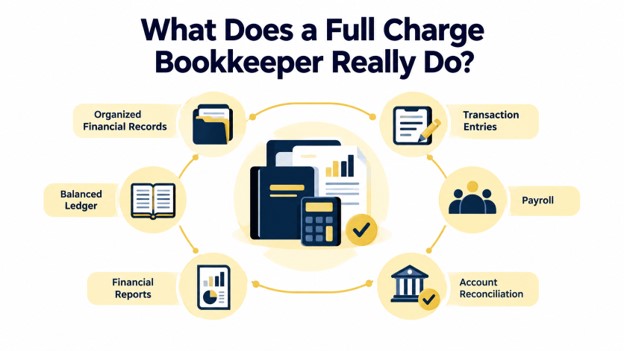
A full charge bookkeeper is responsible for recording transactions, managing accounts payable and receivable, processing payroll, reconciling accounts, and preparing financial statements. Given their extensive reporting responsibility, these roles typically get paid anywhere from $63,000 to $82,500, according to Robert Half’s 2026 Salary Guide.
Here are the typical full-charge bookkeeper responsibilities.
Daily Transaction Duties:
A full-charge bookkeeper manages the company’s books using QuickBooks or similar accounting software. Their monthly bookkeeping checklist usually includes:
- General ledger: Records and categorizes the company’s financial transactions.
- Accounts payable: Enters vendor bills, tracks due dates, and processes vendor payments.
- Accounts receivable: Creates customer invoices, records payments, and follows up on overdue balances.
- Bank reconciliation: Compares the accounting records with bank and credit card statements to identify missing, duplicate, or incorrect transactions.
Payroll Processing:
A typical full-charge bookkeeper job description also includes managing payroll from start to finish. This can include:
- Calculate pay: Processes regular wages, overtime, and employee withholdings each pay period.
- Pay payroll taxes: Calculates and deposits federal, state, and FICA taxes by their due dates.
- File tax forms: Prepares and submits quarterly Form 941 and year-end Form W-2.
- Reconcile payroll: Matches each payroll run to the general ledger before recording it to prevent any payroll mistakes.
Period-End Reporting and Oversight:
When the month or quarter ends, the full-charge bookkeeper helps close the company’s books. This usually includes:
- Trial balance: Confirms that the accounting records are balanced.
- Financial statements: Prepares profit and loss, balance sheet, and cash flow statements.
- Financial reporting: Shares reports with owners, managers, or outside CPAs.
- Staff review: Checks the work of junior accounts payable and receivable staff.
Explore Our Bookkeeping Packages
Talk to our team and find monthly bookkeeping package that fits your business the best.
Full Charge Bookkeeper vs Regular Bookkeeper
A regular bookkeeper only handles specific bookkeeping tasks, such as entering invoices, recording transactions, or reconciling bank accounts. A full charge bookkeeper independently manages the entire cycle, from transaction entry through financial statements, and reports directly to the owner or a controller.
Here’s a side-by-side breakdown of full charge bookkeeper vs bookkeeper.
| Regular Bookkeeper | Full Charge Bookkeeper | |
| Scope | One or two functions (e.g., AP or data entry) | Entire bookkeeping cycle |
| Autonomy | Works under supervision | Operates independently |
| Reports to | Full charge bookkeeper or office manager | Owner or controller |
Full Charge Bookkeeper vs. Accountant
A full-charge bookkeeper manages the daily accounting records, including transactions, payables, receivables, reconciliations, payroll, and reports. A staff accountant analyzes this information for higher-level responsibilities, such as tax preparation, audits, compliant financial statements, and strategic advice.
Here’s how the two roles differ.
| Full Charge Bookkeeper | Accountant | |
| Core function | Records transactions through trial balance | Interprets and reports on financial data |
| Key tasks | AP/AR, payroll, reconciliations, monthly close | Financial reporting, tax preparation, audit support, and advisory |
| Credentials | Not required | Often CPA or accounting degree |
For many small businesses, the best approach is to have a full charge bookkeeper manage daily records, while bringing in external professional accounting services to handle tax compliance and financial reporting. This combination provides accurate bookkeeping and senior-level expertise without the cost of a full-time accountant.
When Does a Business Need a Full Charge Bookkeeper?
A business may need a full-charge bookkeeper when its financial records become too complex for basic bookkeeping software or a part-time bookkeeper to manage accurately.
Here are the clear signs that explain why your business needs a professional bookkeeper.
- Payroll now covers more than a couple of employees
- Books haven’t been reconciled in over a month
- The owner can’t answer “what did we make last quarter” without digging through records
- The CPA is cleaning up the same errors every tax season
What Should You Look for in a Full Charge Bookkeeper?
Beyond years of experience, the strongest signal of a qualified full charge bookkeeper is a recognized certification paired with hands-on software fluency. Here’s what to look for:
- AIPB Certified Bookkeeper credential: Passing a four-part national exam, proving at least 2 years of full-time or 3,000 hours of part-time experience, and signing a code of ethics.
- NACPB certification: Nationally recognized bookkeeping credential, which shows that the bookkeeper has met a tested standard of competency.
- QuickBooks proficiency or equivalent platforms: Daily reconciliation, payroll, and financial reporting happen in accounting software. So, hands-on proficiency matters.
- References from similar businesses: Ask for references from businesses with a similar size and level of complexity. This helps confirm that the bookkeeper has handled a comparable transaction volume before.
FAQs
Q1. What are the responsibilities of a full charge bookkeeper?
A full charge bookkeeper handles the entire bookkeeping cycle independently. They record daily transactions, process payroll, reconcile bank accounts, and prepare financial statements at the end of each reporting period.
Q2. Can a full-charge bookkeeper prepare tax returns?
Yes, a full-charge bookkeeper can prepare the financial statements and preliminary figures for tax returns. However, they cannot sign or file the tax returns unless they have a separate tax credential.
Q3. Does a small business need a full-time full-charge bookkeeper?
Not necessarily. Many small businesses hire a full-charge bookkeeper part-time, work with one remotely, or use an outsourced bookkeeping service instead of hiring someone full-time.
Q4. What software skills matter most for a full-charge bookkeeper?
A strong full-charge bookkeeper should know about QuickBooks, payroll platforms such as Gusto or ADP, spreadsheet reporting tools, and any industry-specific accounting software your business uses.
Q5. How is a full-charge bookkeeper’s work reviewed for accuracy?
Regular reviews help catch errors that daily bookkeeping may miss. This can include CPA reviews, external reconciliation audits, or year-end tax preparation.
Q6. What size company typically employs a full charge bookkeeper?
This role is common in small to mid-sized businesses that have outgrown basic bookkeeping but are not large enough to need a separate dedicated team for accounts payable, accounts receivable, and payroll.
Final Words
A full-charge bookkeeper independently owns the entire bookkeeping cycle, from daily transactions and payroll through period-end reporting. They become especially valuable when your business has outgrown basic bookkeeping support.
At Karme, we handle your full bookkeeping cycle, including QuickBooks, Xero, and FreshBooks management, account reconciliations, payroll, and monthly financial reporting. We tailor our services to your industry and transaction volume so you get the right level of support and financial insights that help your business grow. Talk to our team today to get started.