
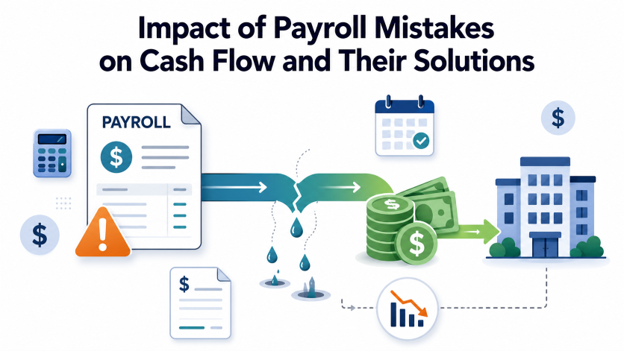
About 3.4 million American employees were affected by a missed payroll in 2024, according to Gusto.
For a small business, this means scrambling for cash on short notice, which can throw off budgets for weeks afterward. It can also lead to serious legal and compliance issues.
That’s why addressing payroll mistakes early on is so important. In this guide, you will learn about the common payroll challenges that small businesses face and how to address them effectively.
To avoid payroll issues, you can also work with a professional payroll service that can monitor your cash flow, identify compliance issues, and help ensure your payroll is processed accurately and on time.
Payroll Challenges By The Numbers
Before looking at the solutions, here is a quick look at how much payroll mistakes are actually costing small businesses in 2026.
- A Gusto analysis found that missed payrolls have increased 54% since 2019. And businesses that miss a payroll see an 8% to 10% decline in their workforce afterward.
- According to the 2025 Small Business Taxation Survey, 23% of small businesses spend more than 3 hours a month just administering payroll taxes internally. It is also the second most burdensome tax they face.
- In 2025, the IRS assessed $1.247 trillion in civil penalties. Employment tax violations accounted for the largest share of those penalties, totaling $1.151 trillion.
Common Challenges in Payroll Processing and Their Solutions
Most payroll problems come from a small number of mistakes that can lead to serious cash flow problems. The good news is that each one has a clear resolution once you understand the cause.
Let’s discuss these common payroll problems and solutions in detail.
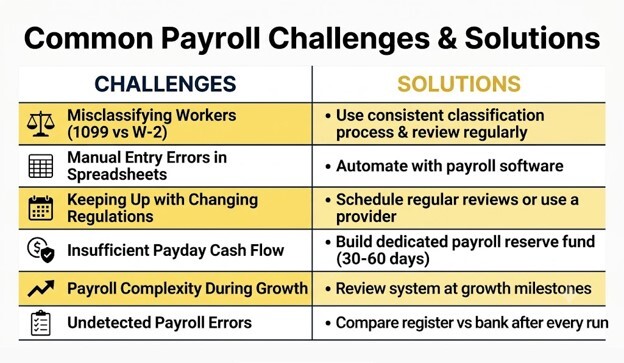
1. Classifying Workers Correctly
Misclassifying an employee can lead to serious penalties and back pay if the mistake is discovered. For example, a landscaping company might pay a full-time helper as an independent contractor using Form 1099 instead of hiring the worker as an employee. If a government agency later reviews the working relationship, the worker may be reclassified as an employee, and the business could owe back taxes and other costs.
Solution:
To avoid this problem, use the same worker classification process for every new hire. Review a contractor’s status again if their work hours, responsibilities, or level of control begin to match those of an employee.
This W-2 vs 1099 guide breaks down the difference in more detail.
2. Reducing Manual Entry Errors
Sometimes challenges in the payroll process stem from simple data entry mistakes. Manually typing employee hours, overtime, tax information, and deductions into spreadsheets increases the risk of errors. Even a small mistake can continue through multiple pay periods if no one notices it.
Solution:
The best solution is to automate payroll tasks whenever possible. Payroll software can calculate taxes, track work hours, and process direct deposits automatically. This reduces the need for manual data entry and prevents many common errors before they happen.
3. Adapting To Changing Regulations
Wage rates, overtime rules, tax rates, filing deadlines, and state requirements can all change over time. Small businesses often find it difficult to keep up because they usually do not have payroll specialists on staff. Ultimately, the payroll and compliance challenges can lead to serious legal issues and costly penalties.
Solution:
The fix is to review payroll tax rates and filing deadlines on a regular schedule instead of waiting until a deadline is close. Another option is to work with a payroll provider that monitors these changes for you. This quarterly tax payment guide covers filing deadlines in more detail.
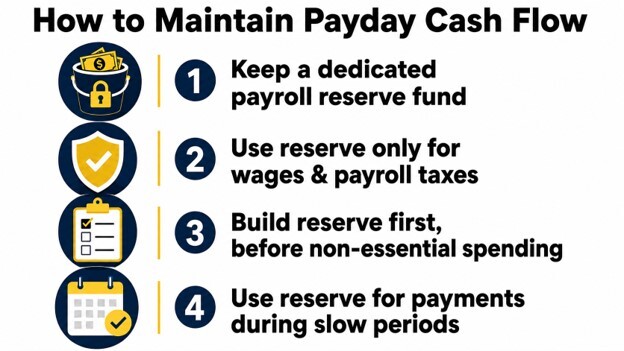
4. Protecting Payday Cash Flow
Payroll is one of the largest fixed expenses for most small businesses. If revenue slows unexpectedly, the business may not have enough cash available to pay employees on time. Missing or delaying payroll can lower employee morale, increase staff turnover, and disrupt daily operations. Ultimately, this can impact your business sales and overall cash flow.
Solution:
Create a separate payroll reserve fund that is used only for employee wages and payroll taxes. Build this reserve before spending money on nonessential business expenses. This helps ensure that employees are paid on time, even during slower business periods.
5. Adjusting Payroll as Your Business Grows
Payroll becomes more complex as a business expands. Hiring additional employees may require new tax registrations, benefit enrollments, or different payroll schedules. Hiring employees in another state can also create new tax withholding and reporting requirements. Failing to meet these needs can lead to penalties and duplicate filings that all pull unplanned cash out of the budget.
Solution:
Review your payroll system whenever your business reaches an important growth milestone, such as hiring your first out-of-state employee or expanding to ten employees. Updating your payroll process early helps prevent compliance problems later.
6. Catching Errors Early
Even businesses with well-managed payroll systems can make occasional mistakes. The problem is allowing those mistakes to continue for several pay periods. An incorrect deduction or a duplicate payment can go unnoticed for months if payroll records are not reviewed regularly.
Solution:
After every payroll run, compare the payroll register with your bank transactions to confirm that all payments and deductions are accurate. Regular reviews make it easier to identify and correct problems before they become expensive. You can also keep a monthly bookkeeping checklist to simplify your routine reviews.
FAQs
Q1. How much cash should a small business keep in reserve for payroll?
A small business should keep enough cash to cover at least one full payroll cycle, ideally 30 to 60 days, in a separate account. This reserve helps the business continue to pay employees on time in times when cash flow is temporarily interrupted.
Q2. What happens if a payroll tax deposit is late?
If a business deposits payroll taxes after the deadline, the IRS may charge a failure-to-deposit penalty. The penalty starts at 2% of the unpaid amount and can increase to 15%, depending on how late the payment is.
Q3. Can payroll mistakes affect employee retention?
Yes. Even one missed paycheck or repeated pay errors may cause employees to question the company’s reliability. Some employees begin looking for another job after a single payroll problem.
Q4. How often should a business audit its payroll process?
A business should review its payroll process at least once every quarter to identify and fix problems as early as possible. It is also important to review payroll after major changes, such as hiring employees in another state or changing the company’s pay schedule.
Q5. How quickly must a business correct a payroll error once found?
A business should correct a payroll error as soon as it is discovered. In many states, any unpaid wages must be included in the employee’s next regular paycheck. Any delays can result in additional penalties or wage claims, depending on state law.
Q6. Does payroll software eliminate the need for a bookkeeper?
No. Software may automate calculations and reduce data entry mistakes. But a bookkeeper still confirms that employees are classified correctly, reconciles payroll accounts, and helps identify compliance issues that payroll software may not detect.
Final Words
Payroll problems are usually caused by cash flow issues, instead of paperwork. To avoid these mistakes, the best solution is to make payroll accuracy part of your regular financial management instead of waiting to fix problems after they happen.
At Karme, we deeply understand the financial challenges small businesses face. Our expert bookkeeping and payroll management services are tailored to your goals, so you can keep your payroll accurate, your financial records organized, and maintain healthy cash flow throughout the year. Schedule a consultation today to get started.