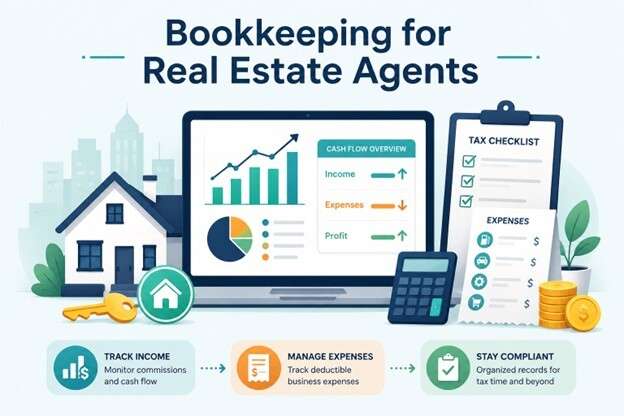
For realtors, a six-figure commission year can still end in a five-figure tax problem. And poor bookkeeping is one of the major reasons.
Real estate agents work as self-employed contractors. So, taxes are not automatically withheld from their income the way they are for regular employees. This makes it critical to keep organized financial records to avoid missing tax deductions and prevent IRS penalties.
Proper bookkeeping for real estate agents makes this easier. This guide explains exactly what income and expenses to track and how to set up a dependable bookkeeping system for realtors. You can also take help from professional accounting services to save your time and prevent costly errors.
Why Bookkeeping for Real Estate Agents Is Different From Other Professions
Managing finances as a real estate agent is not the same as managing finances in a traditional job. Here are the key reasons that make bookkeeping especially important for realtors.
- Independent contractor status: Real estate agents are treated as self-employed, meaning no tax withholding. Agents typically receive Form 1099-NEC and must handle their own quarterly estimated tax payments.
- Commission-based income: Earnings are irregular and unpredictable, with large fluctuations month to month. This makes budgeting, cash flow management, and tax planning more complex than salaried professions.
- High cost of disorganized records: Agents manage numerous deductible business expenses. Poor bookkeeping can lead to missed deductions, tax issues, and difficulties securing loans or financing.
These factors can make bookkeeping for realtors quite challenging. Working with a real estate accounting services provider can help you organize your records, track expenses, manage tax deadlines, and stay financially prepared throughout the year.
Explore Our Bookkeeping Packages
Talk to our team and find the monthly bookkeeping package that fits your business best.
What Income and Expenses Should Real Estate Agents Track?
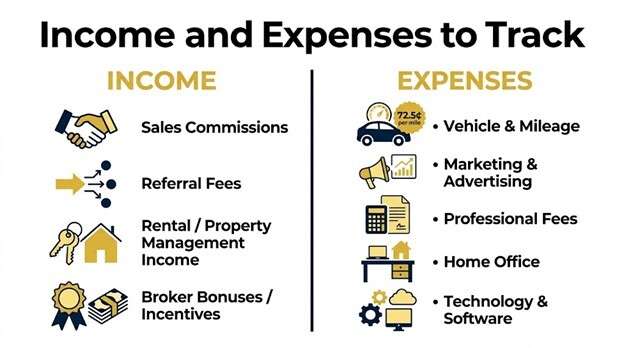
Proper accounting for realtors means keeping a clear record of all income streams, not just commissions. Here’s what you’ll need to track across your income.
- Sales commissions: Record each sale with the closing date, property address, and total commission earned.
- Referral fees: These are taxable income and should be listed separately from commissions.
- Rental or property management income: Include fees earned from managing rental properties.
- Broker bonuses or incentive payments: Record all bonus payments because they are taxable income.
Similarly, accounting for real estate agents includes tracking deductible business expenses, such as the following:
- Vehicle and mileage: In 2026, the IRS updated the standard mileage rate to 72.5 cents per mile. So, agents who drive often for showings and meetings may deduct significant amounts.
- Marketing and advertising: This includes online ads, signs, flyers, photography, and lead generation costs. These expenses are usually deductible.
- Professional fees: Track MLS dues, association memberships, license renewals, errors and omissions insurance, and continuing education costs.
- Home office: If you use a space only for business, you may claim $5 per square foot for up to 300 square feet under the simplified IRS method.
- Technology and software: Include CRM systems, e-signature tools, and transaction management software.
How to Set Up a Bookkeeping System That Works for Realtors?
A good bookkeeping system does not need to be complicated. You do not need accounting training to track all records. They only need a simple system and the discipline to use it regularly. Here’s what you’ll need to do.
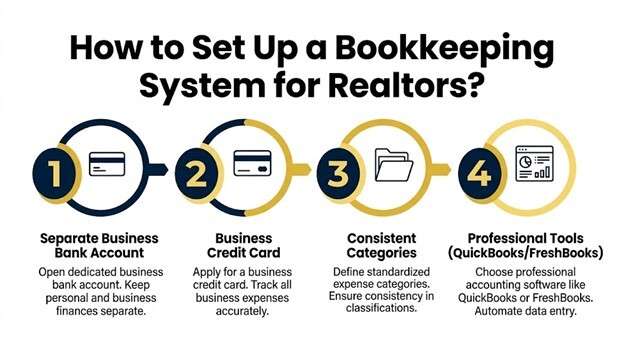
1. Open a Separate Business Bank Account
Use one bank account only for your real estate business. Deposit all commission payments into this account, and pay business expenses from it. This creates a clear record of your income and expenses. It also saves time during tax season because you do not need to separate personal and business transactions.
2. Use a Business Credit Card for Expenses
Use one credit card only for business purchases such as advertising, fuel, office supplies, client gifts, and software subscriptions. Your monthly statement will give you a clear list of business expenses for easier recordkeeping.
3. Categorize Transactions Correctly from the Start
Create clear expense categories and use them consistently throughout the year. Common categories include:
- Marketing and advertising
- Transportation and mileage
- Professional fees
- Office supplies
- Technology and software
- Education and training
Do not change categories without a good reason. Inconsistent records can cause mistakes and make financial reports less accurate, which is one of the key reasons why your business needs a professional bookkeeper to manage a growing volume of transactions.
4. Use Professional Tools to Automate Tasks
Bookkeeping software such as QuickBooks or FreshBooks can help organize income and expenses, track mileage, send invoices, and estimate quarterly taxes. If you want to focus more on your business operations, you can also hire professional bookkeeping services for businesses to do this on your behalf and help you stay on schedule with tax deadlines.
Key Tax Deductions Agents Miss Without Proper Books
Since agents are self-employed, the IRS requires quarterly estimated payments in April, June, September, and January. When your records are organized and current, these deadlines are much easier to manage. Good records also help you claim every deduction you qualify for, because you can only deduct expenses you can prove.
Here are some of the deductions agents often miss, along with the records needed to claim them.
- Mileage: Keep a mileage log that includes the date, destination, number of miles driven, and business reason for each trip. If you do not have a log, the deduction may be denied during an audit.
- Qualified Business Income (QBI): Eligible agents may deduct up to 20% of qualified business income under IRS Section 199A. To claim it correctly, your income and expenses must be accurate and up to date.
- Home Office: You may qualify for a home office deduction only if the space is used regularly and only for business.
- Client Gifts: You can deduct up to $25 per client each year for business gifts, under IRS rules. Without a separate record of gifts, you cannot claim this expense.
- Professional Development: Course fees, certifications, and conference costs are fully deductible when they directly relate to your business.
Based on your financial records, a CPA can help you plan and file taxes and stay compliant with the IRS. Understanding the distinction between bookkeepers vs CPAs can help you decide which professional, or combination of both, best fits your needs.
When to Consider a Bookkeeping Service for Real Estate Agents
At a certain point, managing your own financial records takes more time than it saves. For example, if you complete more than 10 real estate transactions per year, keeping track of everything manually can become difficult. You may miss quarterly estimated tax deadlines, pay less or more in estimated taxes, or lose track of which business expenses are deductible.
Professional accounting services in the USA can take the load off your shoulders. They can record your income, organize and categorize expenses, and prepare your quarterly tax estimates, so you can focus on your listings and clients.
Final Words
Proper bookkeeping for real estate agents gives you a real advantage in your business. When you clearly understand your income, expenses, and profit, you can make better financial decisions, invest money with more confidence, and manage your business more effectively during slow markets.
If you need help managing your financial records, Karme offers online bookkeeping and CPA-reviewed accounting services for small businesses and real estate professionals. We help you maintain accurate books, prepare clear financial reports, and stay compliant with required reporting standards. Get in touch today to maximize your profitability!