
Do I Owe Back Taxes to IRS? How to Find & What to Do Next?
If you have missed filing taxes for a year or more, you might be wondering, “Do I owe back taxes to the IRS?” This is important to know, as overlooked taxes can accumulate unnoticed and turn into a serious financial burden.
This is something many Americans are facing. For 2024 alone, the IRS collected $120.2 billion in unpaid taxes. And 6.1 million accounts were closed during the year, according to IRS data.
Therefore, you should know your status and take action quickly. This guide gives you five practical ways to check if you owe back taxes to the IRS and how to resolve them.
If you need personalized help in this regard, Karme’s qualified team of tax professionals can step in and handle it on your behalf.
Do I Owe Back Taxes? 5 Ways to Find Out
Some life changes, like losing a job or getting a divorce, can also result in back taxes. If you’re wondering, “How do I know if I owe back taxes?” there are five reliable ways to check. Each method gives you useful information, so choose the one that works best for you.
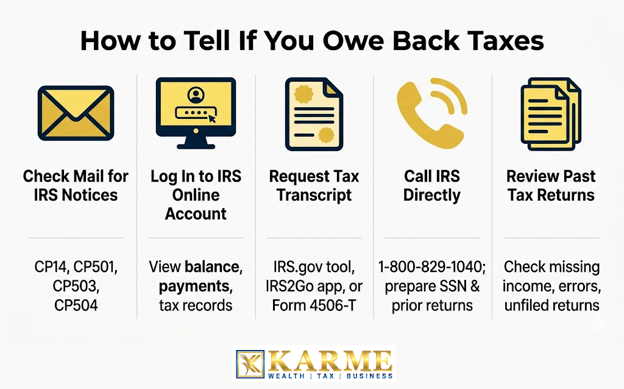
Let’s review these methods in detail.
Way 1. Check Your Mail for IRS Notices
If you owe back taxes, you will usually receive several letters from the IRS, starting with a CP14 notice. If you do not respond, they will follow up with further notices to remind you of your debt. This includes a CP501 notice followed by a CP503 notice, and finally a CP504 to warn you that the IRS may take your state tax refund.
If you still do not respond, the IRS may begin serious collection actions, such as placing a levy. So, make sure to check your mail regularly for IRS letters.
Way 2. Log In to Your IRS Online Account
You can also check for any unpaid balance through your IRS account. Go to IRS.gov and sign in or register a new account. To create an account, you will need to verify your identity through ID.me, so have your government-issued ID card ready.
After you log in, you will be able to see your current balance, payment history, and access tax records for previous years. If any prior year shows an unpaid balance, that means you owe back taxes.
Way 3. Request a Tax Transcript
A tax transcript is an official summary from the IRS that shows your tax filings and any balances for each year. It lists what you filed, what you owed, and any payments or adjustments.
You can request a transcript in three ways:
- Visit IRS.gov and use the “Get Transcript” tool
- Use the IRS2Go mobile app
- Mail Form 4506-T to the IRS
When you review your transcript, you can identify years that are missing returns or have unpaid balances. You can also check when each balance was created. Also, you won’t need to set up a full online IRS account, so it is a faster way to check the status of a specific tax year.
Way 4. Call the IRS Directly
Another option is to speak to an IRS agent directly. To do this, you can contact the IRS via phone at 1-800-829-1040. They can check your account and tell you if you owe back taxes, the exact amount due, and which tax years are involved.
But before calling, make sure you have your Social Security number, a copy of a previous tax return, and any letters you have received from the IRS.
Way 5. Review Your Past Tax Returns for Errors
If you are not sure whether you owe back taxes for a specific year, you can review your previous tax returns. You’ll need to check for any missing income, such as 1099 forms from freelance or contract work, incorrect deductions, or any year when you did not file a return. Finding these issues can help you understand why you might owe money and prepare you to speak clearly with an IRS agent if needed.
Once you understand that you owe back taxes, you’ll need to resolve them quickly to avoid serious consequences.
What Happens If You Owe Back Taxes and Ignore Them?
If you do not resolve IRS taxes, it will increase the amount you owe over time. According to the IRS, penalties and interest are added in the following ways:
- Failure-to-pay penalty: The IRS charges 5% of your unpaid balance each month. This continues until it reaches a maximum of 25% of the total amount you owe.
- Failure-to-file penalty: If you do not file your tax return, the IRS charges 5% of the unpaid amount each month, up to 25%.
In addition to these, the IRS charges interest on your unpaid balance every day, which increases the total amount you owe further.
Moreover, if you do not resolve the debt, the IRS can start taking serious collection actions. These can include placing a legal claim on your property, taking money directly from your bank account or paycheck, or withholding your future tax refunds.
What to Do If You Owe Back Taxes
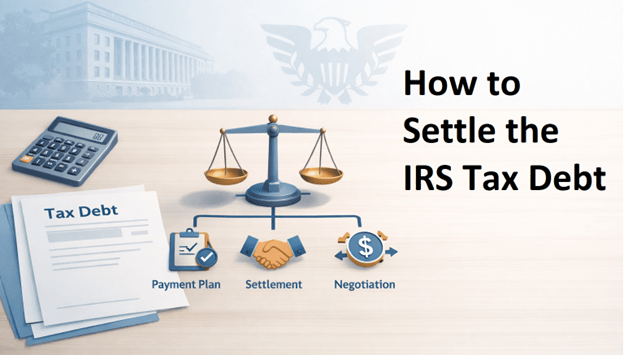
Owing back taxes is stressful, but it is not a dead end. The IRS has structured resolution pathways designed for exactly this situation. Here are four main options available.
1. Pay in Full
If the balance is manageable, paying it off immediately is the most cost-effective solution. It will stop penalties and interest from accumulating the moment the IRS receives your payment.
You can pay using:
- IRS Direct Pay (free, available 24 hours a day)
- A debit or credit card through an IRS-approved payment processor
- The IRS2Go mobile app
- The Electronic Federal Tax Payment System (EFTPS)
2. Set Up a Payment Plan (Installment Agreement)
If you’re unable to pay the full amount all at once, you can pay in installments by setting up a monthly plan with the IRS. To do this, you can apply online at IRS.gov, by phone, or by mailing Form 9465. Once you get in touch with an IRS agent, you will be offered two types of payment plans:
- Short-term plan: Pay the full balance within 180 days
- Long-term plan: Make monthly payments over a longer period
Keep in mind that penalties and interest will continue to grow, but the IRS will pause collection actions as long as you make payments on time.
3. If You Cannot Pay the Amount
If you are facing serious financial hardship, the IRS offers two additional options to relieve your burden.
- Offer in Compromise (OIC): Settle your tax debt for less than the full amount, based on your income, expenses, and assets.
- Currently Not Collectible: The CNC status temporarily stops collection if paying anything would prevent you from covering basic living expenses.
You may also qualify to have certain penalties removed, depending on your situation. To learn more, read our guide on how to settle the IRS tax debt.
Final Words
If you’ve been asking, “Do I owe back taxes?” now you know how to find out and what to do about it. The sooner you take action, the less you’ll have to pay in penalties and interest. A tax professional can help you resolve your debt faster and avoid serious consequences like wage garnishment and levies.
At Karme, our experienced tax professionals provide personalized guidance based on your situation. We help you prepare and file taxes on time, negotiate with the IRS on your behalf, and find the most affordable resolution for your circumstances. Get in touch today.