
What is No Tax on Overtime? Who Qualifies, and How to Claim it
Every week, millions of hourly workers in the United States work overtime. Until recently, all overtime pay was taxed the same as regular income.
This changed on July 4, 2025, when the No Tax on Overtime Deduction became law through the new tax legislation introduced by One Big Beautiful Bill. This law allows eligible workers to reduce the federal taxes they owe on overtime pay.
This guide explains who qualifies for the deduction, how to calculate the amount you can deduct, and how to claim it when filing your taxes.
In practice, the safest approach is to talk to an expert. A qualified tax professional can review your situation and make sure you can maximize this benefit.
What is ‘No Tax on Overtime’?
“No tax on overtime” is a federal tax deduction designed to help workers who earn overtime pay, especially those in lower-paying jobs and many veterans. It reduces your taxable income, which can lower the amount of tax you owe.
If you qualify, you can deduct up to $12,500 per year, or $25,000 if you are married and file jointly, according to the IRS. However, the deduction does not apply to your full overtime pay. It only applies to the extra pay portion, called the “overtime premium.” Under the Fair Labor Standards Act (FLSA), overtime must be paid at time and a half. This means 1.5 times your regular hourly rate.
For example, let’s assume:
- Your regular pay is $20 per hour
- Your overtime pay is $30 per hour
- The extra amount of your overtime premium is $10 per hour
In this case, only the extra $10 per hour will count toward the deduction. The regular $20 per hour does not qualify because you would earn that amount even without working overtime.
That said, you can claim this deduction on Schedule 1-A when filing your federal taxes. You can use it whether you take the standard deduction or itemize your deductions, so you do not have to choose between this benefit and your usual tax filing method.
To learn more about how the IRS calculates and refunds taxes, check out our video guide on how taxes actually work.
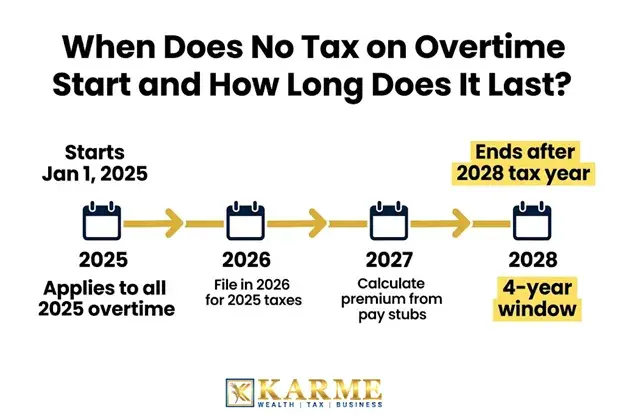
When Does No Tax on Overtime Start and How Long Does It Last?
The tax deduction applies starting January 1, 2025. This means all eligible overtime hours you worked during 2025 count, even though the law was officially signed on July 4, 2025. You can still claim this deduction when you file your 2025 federal tax return in 2026.
Now, how long does this benefit last? As of now, the deduction is scheduled to end after the 2028 tax year. So, you are looking at a four-year window, spread across four filing seasons. After that, it expires. Could it be extended? Yes, but that would require new legislation. So, it is smarter to take advantage of it now rather than assume it will continue.
One more practical point for 2025. Employers are not yet required to clearly separate qualified overtime on W-2 forms. So, you may need to calculate your overtime premium yourself. You can do this using your pay stubs or information from Box 14 of your W-2.
Is There Tax on Overtime? Who Qualifies and Who Doesn’t
Yes, overtime pay is still taxed under the new law. However, if you meet certain requirements, you may owe much less tax on that income. Here is how to tell if you are eligible for this deduction.
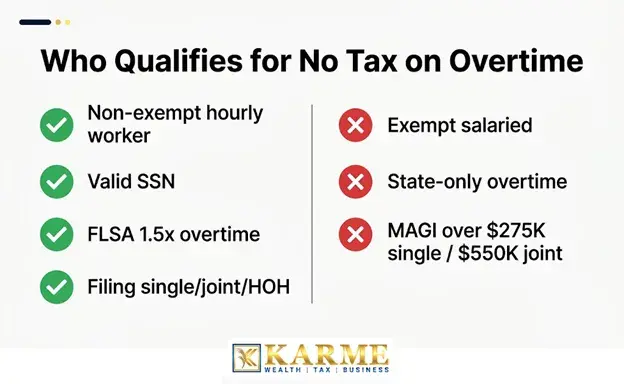
You can qualify if you:
- Are a non-exempt worker under the Fair Labor Standards Act (typically hourly or lower-paid salaried employees).
- Have a valid SSN issued before your tax return due date.
- File as single, head of household, surviving spouse, or married filing jointly (not married filing separately).
- Your overtime is paid at 1.5X your regular rate for hours over 40/week.
You do not qualify if:
- You are an exempt salaried employee.
- Your overtime is based only on state law and is not covered by the FLSA.
- Your modified adjusted gross income (MAGI) is above $275,000 (single) or $550,000 (married filing jointly).
How Does No Tax on Overtime Work?
Now that you know who is eligible for No Tax On Overtime, the real question is: how much do you actually save? To understand how to calculate overtime, you can follow the simple steps below.
Step 1. Find Your Overtime Premium
Use the following formula to calculate your overtime premium.
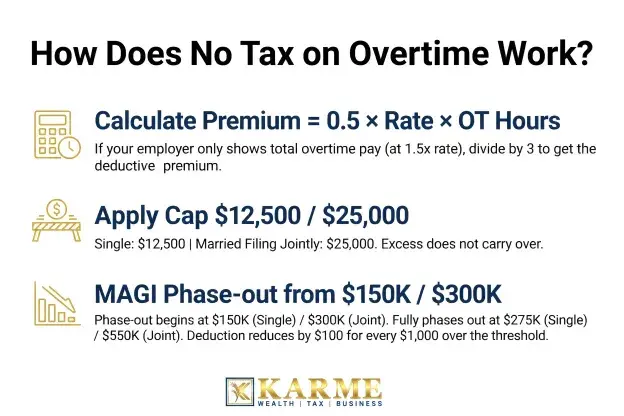
- Overtime Premium = 0.5 × Regular Hourly Rate × Overtime Hours Worked
Now, if your employer just gives you a total overtime amount without a breakdown, you can divide that number by 3. For example, if you earned $12,000 in overtime at the standard 1.5x rate, your premium is $4,000. That’s the part you can deduct.
Step 2. Apply the Annual Cap
Next, compare your premium to the deduction cap. It’s $12,500 if you’re filing single, and $25,000 for married couples filing jointly. If your premium is below the limit, you can deduct the full amount. If it is above the limit, you can only deduct up to the cap. Any extra amount does not carry over to the next year.
Step 3. Factor in your MAGI
Under Section 225(b)(2), your modified adjusted gross income (MAGI) determines whether you get the full deduction.
The phase-out starts at $150,000 for single filers and $300,000 for joint filers. For every $1,000 above this, your deduction drops by $100. Eventually, it phases out completely at $275,000 for single filers and $550,000 for joint filers.
How to Claim the No Tax on OT Deduction on Your Return
Claiming the deduction is a straightforward process, but it does require a few deliberate steps at filing time. Here’s what you’ll need to do.
- Collect overtime records: Use Box 14, pay stubs, or employer statements to total your 2025 overtime.
- Compute premium: Using your records, apply the method from the previous section. If paid time-and-a-half, divide total overtime pay by 3 to find the deductible portion.
- File Schedule 1-A: Report the deduction on this new 2025 form and attach it to Form 1040.
- Transfer to Form 1040: Enter on Line 13b; it reduces taxable income (not AGI).
As you follow these steps, be aware that Social Security (6.2%) and Medicare (1.45%) taxes still apply to overtime pay in full, according to the IRS. Depending on your state, local income taxes may apply as well.
Final Words: Make the Most of No Tax on Overtime
The overtime tax exclusion is a valuable opportunity for workers covered by FLSA. To use it, you must understand how your overtime pay is calculated, confirm that you qualify, and actively claim the deduction when filing your taxes. This benefit is only available through the 2028 tax year, so there is a limited time to take advantage of it.
That said, the rules for eligibility, income limits, and overtime calculations can be complex, especially for workers with multiple jobs or unusual overtime schedules. That’s why working with a qualified tax professional is the safest way to ensure you can claim the full benefit.
At Karme, we are an expert team of tax experts who can review your situation and help you claim the full deduction allowed under the law. Our goal is simple: help you maximize your savings and protect your financial well-being. Get in touch with us today!