If you owe the IRS money but cannot pay without choosing between that bill and your rent, you are not without options. Millions of Americans like you are facing the same situation every year. The good news is that professional tax resolution services can help you find relief you may not know exists.
One of the most overlooked is the Currently Not Collectible (CNC) status. This guide explains what a CNC status means, who qualifies for it, and how you can apply.
What is the Currently Not Collectible Status?
When the IRS determines that you cannot pay your tax debt without failing to cover basic living expenses, it may place your account in Currently Not Collectible (CNC) status. In the IRS system, this is recorded with the code TC 530, also called Status 53. Once active, you can view this among your IRS transcript codes.
What Does CNC Status Imply?
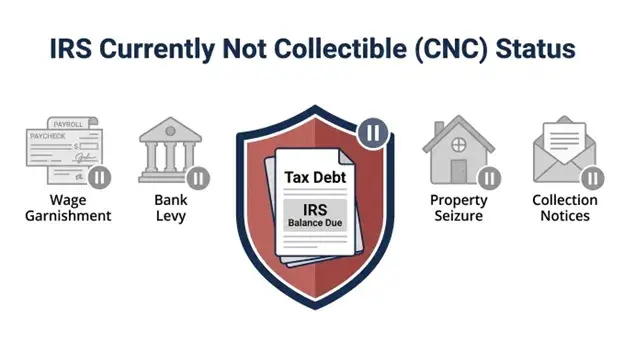
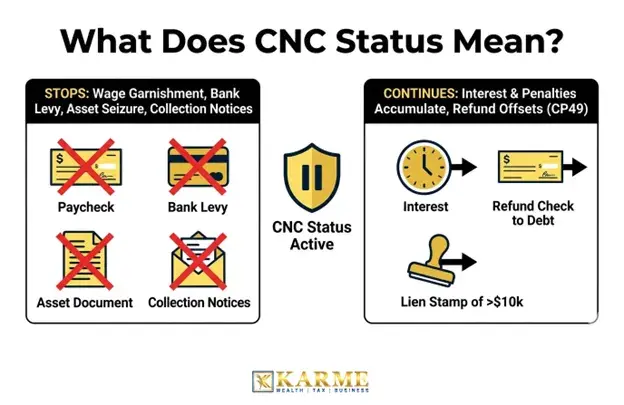
When your account is placed in CNC status, the IRS stops several collection actions, including:
- Garnishing your wages
- Taking money from your bank account through a levy
- Seizing property or other assets
- Sending standard collection notices
However, some parts of your tax debt will continue during this time:
- Interest and penalties will continue to accumulate in the unpaid balance.
- The IRS will apply your future tax refunds to your debt and inform you via a CP49 notice.
- The IRS will file a Notice of Federal Tax Lien if the total amount you owe is more than $10,000.
What CNC Status Does Not Mean:
It’s important to know that a non-collectible status does not eliminate or reduce your debt. It simply means that the IRS has determined that it cannot collect the debt from you at this time.
The IRS will continue to review your accounts periodically. And if your financial situation improves over time, the IRS can restart collection actions and ask you to resume payments.
Who Can Qualify for CNC Status?
According to the Taxpayer Advocate Service, CNC is meant for situations where paying taxes would stop you from covering essential living costs. These would include necessities like food, housing, utilities, and medical care. Simply feeling financially tight is not enough. You must be able to show the financial hardship you’re facing.
How the IRS Measures Your Expenses
The IRS does not simply accept your word to deem your debt as non-collectible. It uses the Collection Financial Standard to evaluate your expenses and which ones to count. These standards are official rules that look at average spending across the country and in specific regions, based on data from the Census Bureau and the Bureau of Labor Statistics.
- Healthcare: In 2026, the IRS allows $84 per month per person for healthcare expenses, or $149 for those aged 65 and older.
- Car payments: The IRS caps car ownership costs at $662 per month for one vehicle. So if you actually pay $1,200 for a vehicle, only $662 is considered in determining CNC status, which can make your financial difficulty seem smaller than it really is.
Core Requirements to Qualify for CNC
You’ll need to meet the following key requirements to be eligible for CNC status.
- Income vs. expenses: Your monthly income must be equal to or less than the IRS-approved monthly expenses.
- Assets: You should not have significant savings, home equity, or retirement accounts that could reasonably pay your tax debt.
- Filed tax returns: You must have filed all required tax returns for previous years. The IRS will not consider CNC for any unfiled years.
- Self-employed taxpayers: You must be current on all estimated tax payments.
How Can You Apply for IRS Currently Not Collectible Status?
To apply for a Currently Not Collectible status, you’ll need to contact the IRS by phone. From there, you can explain your situation and follow the instructions provided by the agent. Here’s how it will work.
- Call the IRS: The process starts by calling the IRS. You can dial 1-800-829-1040 to do this. Otherwise, check out the detailed guide on phone numbers for contacting the IRS for more information.
- State your hardship clearly: When you speak to the agent, it’s important to explain that you cannot make any payment at all, not just that you can’t pay the full amount. If you don’t, the IRS may suggest a partial-payment plan or installment agreement for you.
- Submit a Collection Information Statement. You will have to provide a detailed look at your finances through a Collection Information Statement. If you are an employee or self-employed, you’ll typically use Form 433-A available on irs.gov. Along with the form, you should have supporting documents ready, such as bank statements, pay stubs, and records of your living expenses.
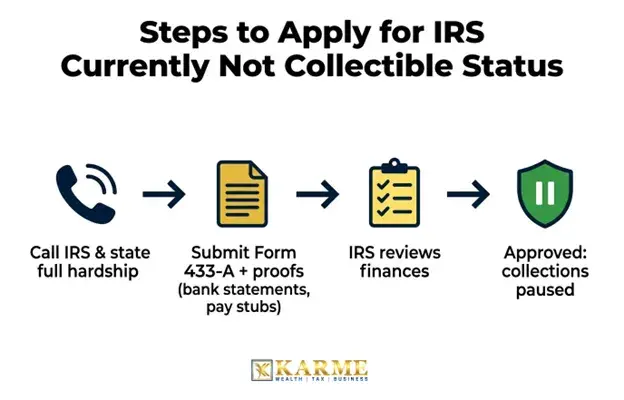
After submitting your information, the IRS will review your case and decide whether to grant CNC status. If approved, they will pause any collection activity on your account. If you’re still unsure what to do, you can discuss your situation with Professional Tax Preparation services. They can contact the IRS and help guide you through this process.
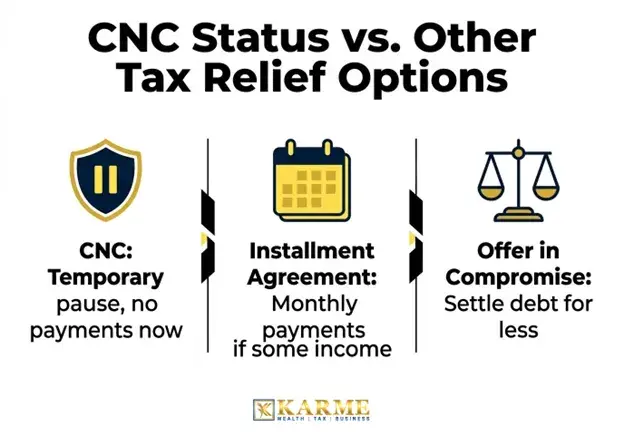
CNC Status vs. Other Tax Relief Options
Currently Not Collectible is just one way the IRS can provide tax relief. If you do not qualify for CNC, there are other options you can consider depending on your financial situation.
- IRS Installment Agreement: It lets you pay your tax debt in monthly installments. This option is generally available if you have some disposable income each month.
- Offer in Compromise (OIC): This allows you to settle your debt for less than the total amount you owe. To qualify for an OIC, you’ll need to provide your detailed financial information to the IRS.
Final Words
Currently Not Collectible status is a legitimate relief program for those who genuinely cannot pay their taxes without giving up basic living necessities. When you’re in CNC status, the IRS will stop its collection efforts. This gives you the breathing room to get your finances under control without the threat of levies closing in.
If you believe you may qualify for CNC status or want to explore other IRS relief options, the next step is to consult a qualified tax professional. Karme can assess your situation and help you act before your tax debt becomes harder and more expensive to resolve. Get in touch today to find the most effective solution for your case.