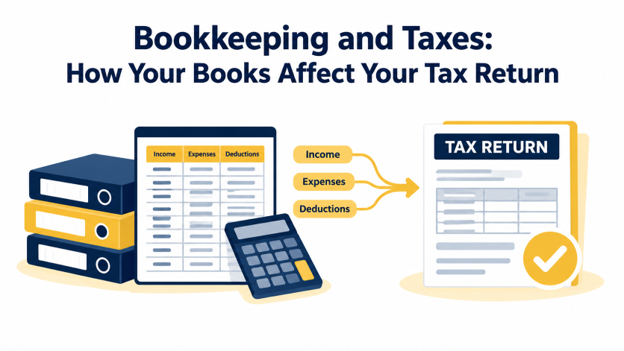
Bookkeeping and taxes are closely connected because your financial records determine how accurately you report business income, claim eligible deductions, and calculate taxable profit.
This article explains exactly how bookkeeping and taxes work together, which bookkeeping records you need, and how to stay tax-ready every year.
To keep your financial records accurate and organized, you can also work with small business bookkeeping services that make it easier to prepare your tax return and support the figures you report.
How Bookkeeping and Taxes Connect to Your Tax Liability
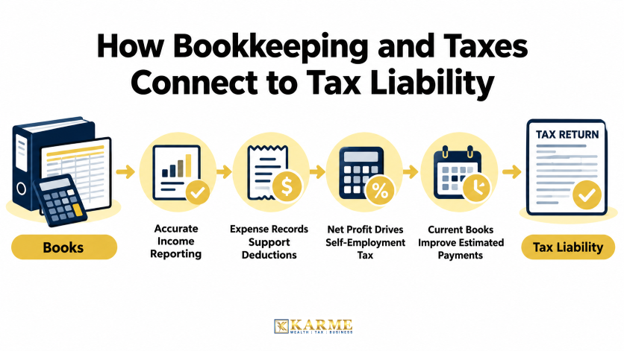
Your tax return starts with your books. Accurate bookkeeping helps you report the right income, claim valid deductions, and calculate quarterly estimated tax payments. When your records are incomplete, you risk reporting the wrong income or paying more in taxes than necessary.
Here’s how it all works.
Accurate Books Prevent Income Errors
Sole proprietors do not receive W-2 forms for their business income, and third-party reporting may cover only part of their earnings. That makes accurate bookkeeping essential. For example, a salon that records only card payments could accidentally leave $5,400 in annual cash service revenue off its tax return.
Expense Records Support Tax Deductions
Your tax preparer can only claim deductions supported by your records. Accurate bookkeeping helps you keep tax deduction records, including receipts that show each expense’s date, amount, vendor, and business purpose.
According to the 2024 NFIB Tax Survey, 90% of small business owners used a professional tax preparer for their latest return. To make that process smoother, professional accounting services can help you maintain accurate books and identify eligible deductions.
Accurate Profit Determines Self-Employment Taxes
For sole proprietors and partners, net profit affects both income tax and self-employment tax. You generally owe self-employment tax when your net earnings from self-employment reach $400, subject to IRS rules.
Your books calculate net profit by subtracting business expenses from revenue. If you miss a sale or record an expense incorrectly, your reported profit changes. That can affect both your income tax and self-employment tax.
Current Books Improve Estimated Tax Payments
Estimated tax payments let you pay your tax liability throughout the year. Up-to-date profit and loss statements help you calculate quarterly tax payments based on your actual business performance instead of relying only on last year’s tax return. This way, you can keep payments closer to what you owe, which reduces the risk of a large tax bill or an underpayment penalty.
Which Bookkeeping Records Do You Need for Tax Purposes?
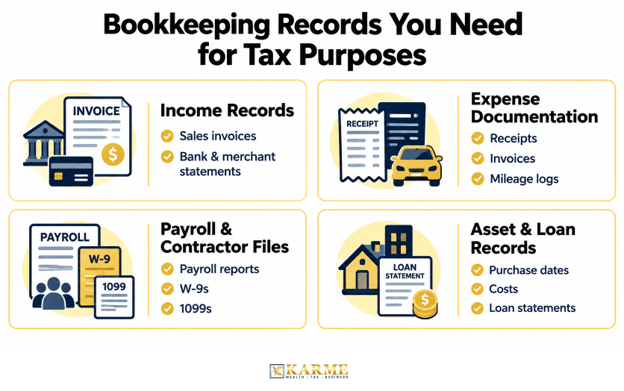
Bookkeeping for tax purposes needs accurate records that support your reported income, deductions, and other tax figures. Here are the exact documents you need to verify each amount and prepare your return accurately.
Income Records
Keep sales invoices, sales reports, bank statements, and merchant statements.
Expense Documentation
Save receipts, vendor invoices, and mileage logs showing the date, amount, and business purpose. Categorize expenses such as advertising, supplies, utilities, and contract labor to support your deductions.
Payroll and Contractor Files
Keep payroll reports, filed payroll tax forms, and Form W-9 for each contractor. Classify workers correctly as employees or independent contractors and record all payments.
Asset and Loan Records
Record each business asset’s purchase date, cost, and in-service date. Keep loan statements, too, so you can separate deductible interest from principal payments.
How to Keep Your Books Tax-Ready Throughout the Year
Only 26% of owners feel completely confident about their taxes, and 35% say organizing receipts is their top challenge (FreshBooks, 2025). Tax-ready books come from small monthly habits that keep bookkeeping and tax preparation connected.
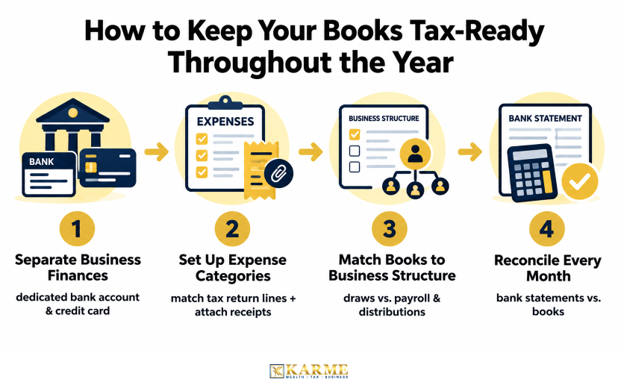
Separate Business Finances
Open a dedicated business bank account and credit card you can use for all business transactions. This keeps your expenses in one place, so you can identify deductible costs without sorting through personal purchases at tax time.
Set Up Business Expense Categories
Group your business expenses into categories that match your tax return, such as advertising, supplies, software, travel, and payments to contractors. Keep the receipt for each purchase as proof of the expense.
Match Books to Your Business Structure
Your business structure, such as an LLC or S corporation, affects how you record money you take out of your business. Sole proprietors and owners of single-member LLCs taxed as sole proprietorships generally record personal withdrawals as owner’s draws rather than business expenses. If you own an S corporation and work in the business, you generally need to receive reasonable compensation through payroll, while additional shareholder distributions are recorded separately.
Reconcile Books Every Month
Check your bookkeeping records against your bank and credit card statements every month. Also, compare your recorded income with reports from payment platforms and the 1099 forms you receive. These checks help you catch mistakes early, so you have less to fix when tax season arrives.
Want to keep your books organized without doing all the work yourself? Karme offers flexible monthly bookkeeping packages based on your business expenses and budget. You can keep your financial records accurate and ready for tax filing without putting unnecessary pressure on your budget.
FAQs
Q1. How long should I keep business tax records?
In most cases, keep business tax records for at least three years after filing your return. You may need to keep them for six years if you underreport gross income by more than 25%, or seven years if you claim a bad debt or worthless securities loss.
Q2. Can I still deduct an expense if I lost the receipt?
Possibly. Bank and credit card statements show that you paid, but they may not prove what you bought. Back them up with invoices, emails, or calendar entries that explain the expense. Without enough documentation, the IRS may disallow the deduction.
Q3. Should my business use cash or accrual accounting?
Most small businesses can choose either method, but C corporations with average annual gross receipts above $32 million for the 2026 tax year must use accrual accounting, based on IRC Section 448.
Q4. Are bookkeeping fees tax deductible?
Yes. You can deduct business bookkeeping fees as ordinary and necessary business expenses. Sole proprietors report these costs under legal and professional services on Schedule C. Other business entities deduct them on their respective tax returns.
Q5. What if I find a bookkeeping error after filing?
Correct your books first, then amend your tax return if necessary. Sole proprietors can use Form 1040-X, while C corporations use Form 1120-X. Partnerships and S corporations usually file corrected returns marked as amended, depending on the type of error and applicable filing requirements.
Q6. Do I need to keep paper receipts?
No. The IRS accepts electronic records as long as your system stores, organizes, and reproduces them clearly when requested. Scanned receipts and cloud-based accounting records can meet these requirements if they preserve accurate, readable copies for an IRS examination.
Final Words
Bookkeeping and taxes go hand in hand. Accurate monthly books help you report the right income, claim supported deductions, and avoid surprises when tax season arrives. Professional help keeps everything on track, even when you are busy.
At Karme, we categorize every transaction and reconcile your bank and credit card accounts each month. This gives reliable numbers to work with. Our monthly reports also help you track profits throughout the year. Contact us today to keep your books accurate and your tax preparation on track.