
The 2025 IRS Data Book recorded 339,137 levy actions in a single fiscal year, and wage garnishment was among the most common. If you’re dealing with one, you know how quickly it can affect your finances.
Unlike most creditors, the IRS does not require a court order to garnish your wages. In Texas, IRS wage garnishment can also override state wage protections that normally shield your paycheck.
This article walks you through the IRS notice sequence, how much of your paycheck the IRS can legally take, and the options available to stop it. If garnishment is already active, a professional Tax Resolution Service like Karme can help you respond quickly.
What is IRS Wage Garnishment?
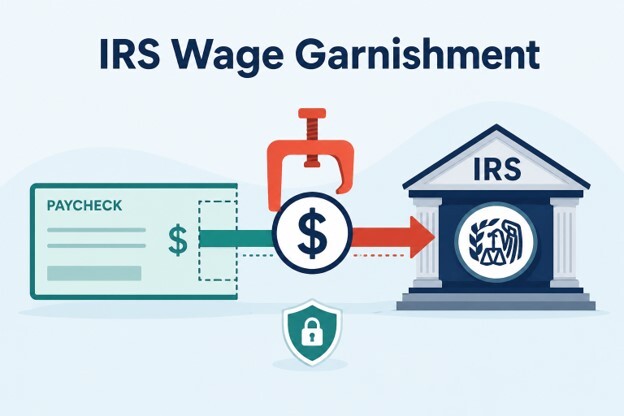
IRS wage garnishment, technically called a continuous wage levy under IRC §6331(e), is a federal collection tool. It allows the IRS to require your employer to withhold part of every paycheck and send that money directly to the IRS.
Texas is known for having strong wage protections. In fact, it is one of the few states where private creditors generally cannot garnish wages for consumer debts, such as credit card balances or medical bills. But those protections do not apply to the IRS. So, if you owe back taxes and have not responded to IRS collection notices, the IRS can garnish your wages no matter where you live.
How the IRS Garnishes Your Wages: Understanding the Notice Sequence
Before the IRS garnishes wages, it sends a series of IRS letters over several weeks or even months. The good news is that taking action at any stage can help prevent wage garnishment.
- Early Warning Notices: The process begins with the CP14 about overdue balance. If you do not respond, the IRS follows up with the CP501 and then the CP503.
- The CP504 Notice: Next comes the CP504, which tells you that the IRS intends to levy your state tax refund. It is a serious warning that the IRS is moving closer to enforcement action.
- Final Notice: LT11 or Letter 1058 is the Final Notice of Intent to Levy. Once it is issued, you have 30 days to respond. If you do not, the IRS can move forward with wage garnishment by sending Form 668-W to your employer.
How Much Can the IRS Take From Your Paycheck?
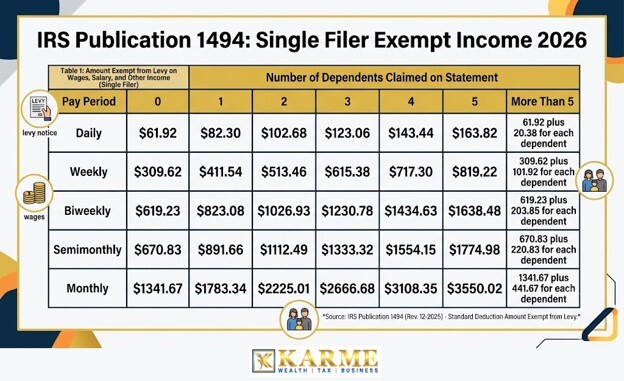
Unlike private creditors, who are capped at roughly 25% of disposable income, the IRS wage garnishment has no percentage cap. It uses a fixed exempt-income table called IRS Publication 1494 and takes everything above your protected amount, which can reach 50% to 70% or more of your net pay.
So, how much of your paycheck is protected? It depends on three factors:
- Your filing status, such as single, married, or head of household
- The number of dependents you claim
- How often you get paid, whether weekly, biweekly, or monthly
For example, if you’re a single filer in Texas with no dependents and earn $1,200 per week, you keep only the protected amount listed in the IRS table. Your employer must send the rest to the IRS each payday.
The following table shows the amount exempted from a notice of levy for a single filer in 2026.
A Step That Directly Affects How Much You Keep
One thing many people overlook is that if you do not return the Statement of Dependents and Filing Status (Form 668-W) to your employer within three business days of receiving the levy, the IRS automatically uses the least favorable exemption of a single filer with zero dependents. So, returning the form quickly is one of the fastest and easiest ways to increase your protected amount and keep more of your paycheck.
How to Stop IRS Wage Garnishment in Texas
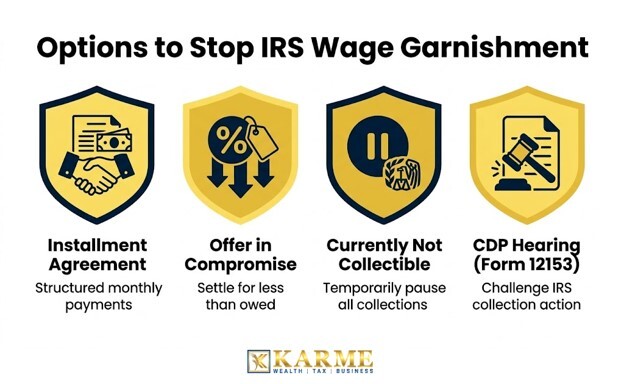
If the IRS has already started garnishing your wages, there are still several ways to stop it. The best option depends on your financial situation and where you are in the IRS collection process.
Payment Plan
An IRS Installment Agreement (IA) is the most common way to settle tax debt available to taxpayers who owe $50,000 or less. Under IRC §6159, once an IA is approved, the IRS must release the wage levy.
Offer in Compromise
An Offer in Compromise (OIC) allows qualifying taxpayers to settle their tax debt for less than the full amount owed based on demonstrated inability to pay. Filing an OIC will also stop wage garnishment or any levy action while the offer is under IRS review.
Currently Not Collectible
If paying your tax debt would make it difficult to cover basic living expenses, the IRS may place your account in Currently Not Collectible (CNC) status under IRC §6343. This stops collection efforts immediately, including wage garnishment.
CDP Hearing Request
If you are still within 30 days of receiving the Final Notice (LT11), you can file Form 12153 and request a Collection Due Process (CDP) hearing. This will pause any levy action while your case is being reviewed. It also gives you the opportunity to request an installment agreement, submit an OIC, or seek CNC status.
FAQs
Q1: How much can the IRS garnish from your wages?
The IRS does not follow a garnishment cap. Instead, it takes everything above your exempt amount, which is determined by Publication 1494 based on your filing status, number of dependents, and pay frequency.
Q2: Can the IRS take your whole paycheck?
No. The IRS is required to leave you the associated exempt amount from Publication 1494. However, if you fail to return the dependents statement to your employer within 3 business days, the IRS applies the minimum exempt amount. That allows it to take a larger portion of your wages.
Q3: Can the IRS garnish your wages after 10 years?
In most cases, no. The IRS has a 10-year collection period under IRC §6502. However, certain actions, such as filing an Offer in Compromise, requesting a CDP hearing, or filing for bankruptcy, can pause the clock and extend the collection period.
Q4: What percentage does the IRS take from your paycheck?
The IRS does not use any fixed percentage for wage garnishment. Unlike private creditors, capped at roughly 25%, the IRS takes everything above your Publication 1494 exempt amount, which is a fixed dollar figure, not a percentage of your income.
Q5: Will IRS wage garnishment show up on my credit report?
No. Wage garnishment itself does not appear on your credit report. However, if the IRS has filed a Notice of Federal Tax Lien, that separate action may appear in public records and could affect your creditworthiness.
Q6: Is my employer allowed to fire me because of a wage garnishment?
No. Federal law under Title III of the Consumer Credit Protection Act protects employees from being fired because of a single wage garnishment. However, those protections may not apply if you have multiple garnishments from different creditors at the same time.
Final Words
IRS wage garnishment can bypass Texas’s strong wage protections and have a major impact on your finances. That’s why responding to IRS notices as early as possible is so important. The sooner you act, the more resolution options you may have.
If you’re facing a wage garnishment or want to stop one before it starts, Karme can help. Their tax resolution services guide clients through IRS collection issues, negotiate solutions, and work to protect their income. In many cases, getting professional guidance early can make a meaningful difference in the outcome. Get in touch today!