
Texas does not have a state income tax, but the IRS can still take money from your bank account if you owe federal taxes. This action is called an IRS bank levy. A bank levy allows the IRS to legally withdraw money from your account to collect unpaid federal tax debt.
According to the IRS Data Book 2025, the IRS requested 313,792 notices of levy on third parties, including bank levies across the United States, in FY 2024.
If your bank account has been frozen or you want to avoid a bank levy, this guide explains how this process works and what options are available to have the levy released. You can also consult a qualified tax resolution service to understand your options and respond effectively.
What is an IRS Bank Levy?
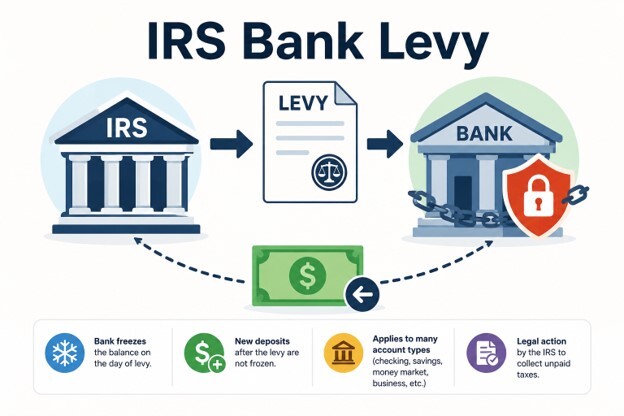
An IRS bank levy is a legal action the IRS can use to collect unpaid taxes. If you have overdue tax debt and do not resolve it, the IRS can instruct your bank to freeze and send money from your account to the IRS.
When the bank receives the levy notice, it freezes only the money that is in the account on that day. The levy does not automatically apply to money deposited after the bank receives the notice.
The IRS can levy many types of accounts, including checking, savings, money market, and business accounts, as long as it can identify the account.
If you are not sure whether you owe back taxes, check your IRS account or tax records as soon as possible. Taking action early may help you avoid collection actions such as a bank levy.
How Does an IRS Bank Levy Work?
The IRS sends several notices and gives you multiple opportunities to respond before it takes money from your account. Below are specific stages of this process.
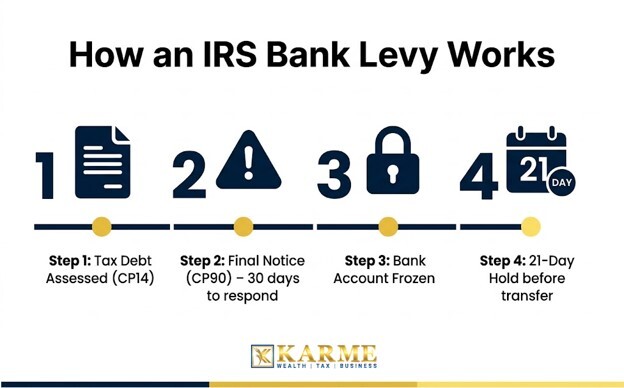
Step 1: Tax Debt Assessed
The IRS calculates the amount you owe and sends a bill called a Notice and Demand for Payment, usually Notice CP14. If you do not respond to these early IRS letters or make payment arrangements, the IRS can move forward with collection actions.
Step 2: Final Notice Issued
If the balance remains unpaid, the IRS sends a Final Notice of Intent to Levy, usually Notice CP90 or Letter LT11. This notice gives you 30 days to request a Collection Due Process (CDP) hearing and challenge the proposed levy.
Step 3: Bank Account Frozen
If you do not respond within 30 days, the IRS can send a tax levy on your bank account directly. As a result, the bank must freeze the money in your account, up to the amount you owe, based on the account balance on the day the levy is received. Deposits made after that date are not included in that levy, although the IRS may issue additional levies later.
Step 4: The 21-Day Hold
Under IRC §6332, your bank must hold the frozen funds for 21 calendar days before transferring them to the IRS. This is your last window to negotiate a release or arrange a resolution. After 21 days, the funds are gone.
Does Texas Protect You from IRS Bank Levies?
Although Texas law protects many types of property from private creditors, those protections do not apply when the IRS collects unpaid federal taxes. However, the IRS cannot automatically take every dollar in your bank account. Some types of funds are protected under federal law, including:
- Social Security benefits
- Unemployment benefits
- Workers’ compensation payments
- Certain pension and retirement payments
- Money that belongs to someone else and is being held in trust
How to Get a Bank Levy Released from the IRS
After applying a tax levy on a bank account, the IRS waits 21 days before taking the money. During this time, you can stop the levy by using one of the IRS-approved resolution options below.
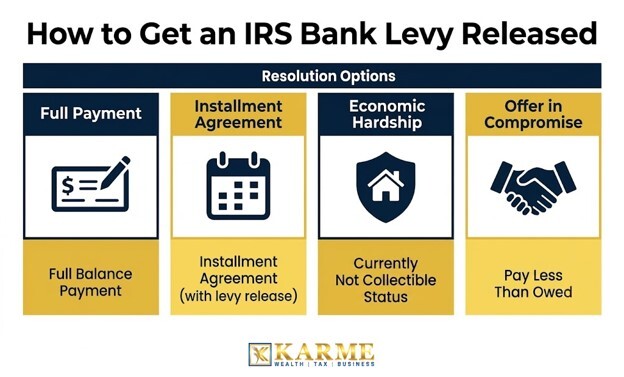
Full Balance Payment
Paying everything you owe, including taxes, penalties, and interest, is the fastest and most direct way to resolve a bank levy. While this option is not practical for every taxpayer, it provides the quickest resolution.
Installment Agreement
An installment agreement allows you to pay your tax debt over time through monthly payments. However, this only works if the IRS specifically agrees to release the levy as part of the installment agreement. So make sure you understand your tax settlement options and rights to effectively negotiate with the IRS and open up paths that aren’t obvious.
Economic Hardship
Under IRC §6343(a)(1)(D), an IRS levy on bank account must be released if it prevents you from meeting basic living expenses such as rent, utilities, food, or medical care. If you qualify, your account may be placed under Currently Not Collectible status, which temporarily stops the IRS collection efforts.
Offer in Compromise
An Offer in Compromise allows eligible taxpayers to settle their tax debt for less than the actual amount owed. However, the IRS must accept your offer, and you must pay the agreed settlement amount to have the levy released. Because an OIC application can take several months of review, you can also request a temporary payment arrangement or CNC status while waiting for a decision.
Frequently Asked Questions
Q1. How often can the IRS levy my bank account?
The IRS can levy your bank account more than once or multiple times. If the current levy does not pay your full tax debt, the IRS can issue additional levies later and collect money from future deposits.
Q2. Can the IRS levy a joint bank account?
Yes. The IRS can levy a joint bank account if one of the account holders owes federal taxes. If the other account holder does not owe the tax debt, they can file a wrongful levy claim with the IRS to request the return of their share of the money.
Q3. Will the IRS notify me before freezing my account?
Yes, the IRS will notify you by sending a Final Notice of Intent to Levy (CP90 or LT11) at least 30 days before levying. However, once that notice is issued, the IRS contacts your bank directly.
Q4. Does a levy affect my credit score?
An IRS bank levy is not reported to the major credit bureaus and does not directly affect your credit score. However, if the levy causes missed payments, returned checks, or overdrafts, and those problems are reported by your bank or creditors, your credit score could be affected indirectly.
Q5. Can the IRS levy a business bank account?
Yes. The IRS can levy a business bank account if the business owes federal taxes, unpaid payroll taxes, or other federal tax liabilities. The IRS may also take collection action based on a business owner’s personal tax debt, depending on the circumstances.
Q6. What happens if my account is empty when levied?
If your account has no money or less money than the amount owed, the IRS may later issue another levy or use other collection methods to collect the remaining tax debt from future deposits.
Final Words
An IRS bank levy follows a clear notice trail, and responding at any stage can stop enforcement before it affects your account. Working with an experienced tax professional can make a meaningful difference in choosing the best solution for your situation.
At Karme, we have helped many individuals and businesses effectively resolve IRS tax problems by obtaining levy releases, setting up installment agreements, submitting Offers in Compromise, and requesting CNC status. If the IRS has levied your bank account or you’ve received a Final Notice of Intent to Levy, talk to our team to find the best resolution for your situation.