

Outdated tax estimates and underfunded retirement accounts usually do not show up until the end of the year. By then, there is very little time left to make corrections.
That is why a financial planning checklist is so valuable for Texas business owners. It helps you identify gaps in tax planning, retirement contributions, cash flow, and other key financial areas while there is still enough time to make adjustments.
This article provides a comprehensive mid-year financial planning checklist to simplify your review process. If you need expert guidance, you can also work with professional financial planning services to guide the process from start to finish.
Mid-Year Financial Planning Checklist for Businesses
The following checklist outlines the key financial areas Texas business owners should review at mid-year and make informed decisions for the remainder of 2026.
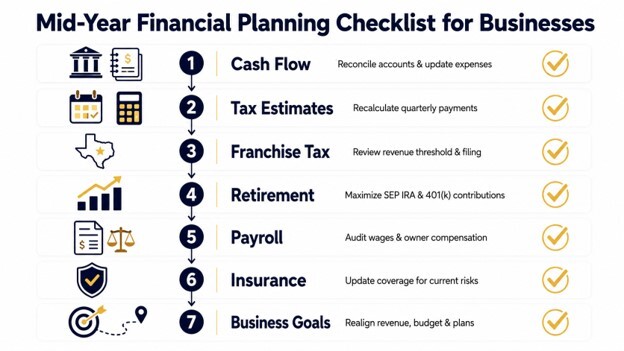
Review Cash Flow and Bookkeeping Accuracy
Clean and up-to-date books are the foundation of every financial decision, including tax planning, payroll management, and retirement contributions. If you have been maintaining your books consistently each month, this review will be faster and more reliable.
An ideal checklist for financial planning should include these two tasks:
- Reconcile every bank account and credit card statement with the general ledger. This process identifies missing, duplicate, or incorrect transactions before they affect your financial reports.
- Review and update expense categories. Check your recurring costs that may have increased or changed since January. These can be expenses like software subscriptions, service agreements, and vendor contracts.
Reassess Your Quarterly Tax Estimates
If your business revenue, expenses, or profits have changed since January, the estimates calculated at the beginning of the year may no longer reflect your current tax liability.
Recalculate your projected taxable income before making your next estimated payment. Updating your estimates now helps prevent underpayments, reduces the risk of IRS penalties, and improves cash flow planning for the remainder of the year.
For most businesses, the third federal estimated tax payment for the 2026 tax year is due on September 15, 2026. Reviewing your quarterly tax payment estimates well before the deadline provides enough time to adjust your payment amount if necessary.
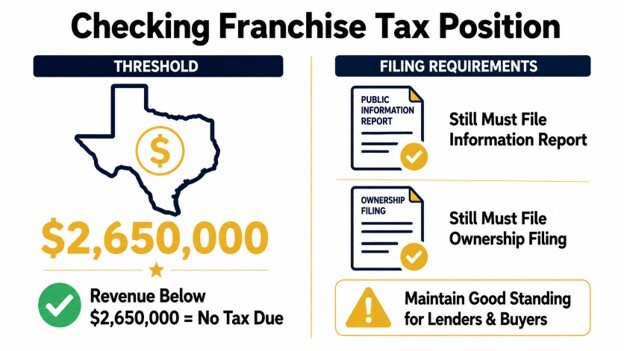
Check Your Texas Franchise Tax Position
While there is no personal income tax in Texas, the state still charges an entity-level franchise tax. For the 2026 to 2027 report years, businesses with annualized revenue below $2,650,000 owe no franchise tax. However, they still need to file a public or ownership information report.
Many owners assume that “no tax due” means “nothing to file” and discover the mistake only when a lender or potential buyer asks for proof that the business is in good standing. A mid-year review with business tax planning services can help you avoid this problem.
Maximize Retirement Plan Contributions
A great checklist for financial planning must include regular reviews of your retirement plan contributions. Don’t wait until the end of the year, when cash flow can become less predictable.
For 2026, the IRS allows SEP IRA contributions of up to $72,000. That gives business owners a valuable opportunity to grow retirement savings while reducing taxable income.
Also, if you review your recent bookkeeping results now, you will be able to estimate your full contribution more easily and fund your SEP IRA or Solo 401(k) with confidence.
Audit Payroll and Review Owner Compensation
For most Texas businesses, payroll is one of the biggest operating expenses. It is also one of the most common areas where financial errors happen.
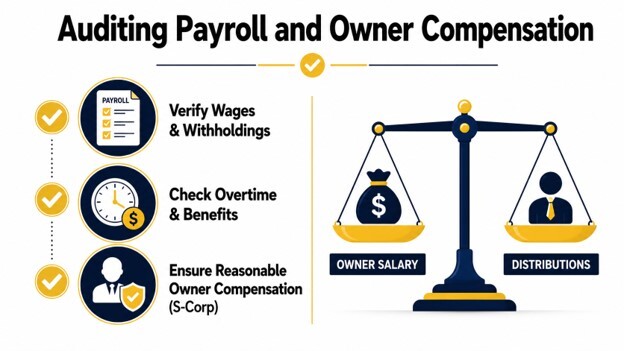
A mid-year payroll audit helps you confirm that employee wages, tax withholdings, overtime pay, benefits, and payroll tax filings are all accurate. If you find any payroll mistakes, fix them now before they affect your financial statements or create compliance problems.
If your business is an S corporation, this is also the right time to review owner compensation. Compare the owner’s salary with shareholder distributions. Make sure the salary is reasonable based on the owner’s role, responsibilities, and the services they provide to the business.
Strengthen Insurance and Risk Coverage
Next, make sure to take a fresh look at your business insurance. Review your liability, property, workers’ compensation, key person, cyber, and any other relevant coverage to make sure it still reflects your current operations.
If your business has grown, hired more employees, expanded operations, or purchased new equipment, your existing coverage may no longer be enough.
So, update your policies where needed. This helps reduce the risk of uninsured losses and ensures your coverage matches your business’s current size, assets, and operational risks.
Realign Your Second-Half Business Goals
Finally, use the financial information from this review to update your plans for the second half of 2026. Base your decisions on your company’s current financial performance rather than on the assumptions you made earlier in the year.
As you do this, adjust your revenue goals, hiring plans, capital investment plans, operating budget, and cash flow forecast to reflect the latest results. This process helps you turn financial information into practical business decisions.
FAQs
Q1. How is a mid-year checklist different from a year-end financial planning checklist?
A mid-year review helps you adjust your financial estimates while there’s still time to make changes. A year-end checklist is about finalizing the numbers and getting everything ready for tax filing.
Q2. How often should a Texas business owner revisit their financial plan?
Most financial advisors suggest a full review twice a year, once at mid-year and again at year-end. A quick quarterly check-in, especially around estimated tax payments, also helps keep things on track.
Q3. Does a Texas franchise tax filing apply to a single-member LLC with no employees?
Yes. Even if your LLC has no employees, you still need to file under Texas franchise tax rules. The amount of tax depends on your revenue, but the filing requirement still applies.
Q4. What documents should a business owner gather before a mid-year review?
Start with your year-to-date profit and loss statement and balance sheet. Then gather payroll reports, prior estimated tax vouchers, and retirement contribution records. Together, these documents give you a clear view of your financial position.
Q5. Can a mid-year review actually lower next year’s tax bill?
Yes. Taking action in the middle of the year gives you more flexibility. You can adjust your business entity structure, increase retirement contributions, or time certain expenses to legitimately reduce taxable income before year-end.
Q6. What happens if a Texas business skips its mid-year financial checkup entirely?
Missing a mid-year financial checkup can turn small issues into much bigger problems. Cash flow gaps, underpaid estimated taxes, and missed retirement contribution opportunities often show up in the fourth quarter, when there is much less time to fix them.
Final Words
A mid-year financial planning checklist allows you to review your cash flow, compensation, and other key financial areas and make adjustments while you still have time. This gives you a stronger foundation for every decision you make during the rest of the year.
If you are a Texas business owner, you do not have to manage outdated tax estimates, missed franchise filings, or retirement contribution limits on your own. At Karme, we connect you with licensed professionals who use tax-smart strategies to help you build a clear budget, reduce tax exposure, increase disposable income, and turn your mid-year numbers into a practical plan for growth. Contact us now to get started